Parrot Time is a linguistic and cultural emagazine published bimonthly by the Parleremo language learning community. The magazine’s editor-in-chief, Erik Zidowecki, contacted me based on our conversations about the Faroe Islands to ask whether I would be interested in helping him put together a special issue focusing on Faroese topics. Naturally, I was very excited to work on the project. With the help of four Faroe Islanders, we published eleven articles on subjects ranging from summer festivals on the islands and the new feature film Ludo to the presence of Danish in Faroese life and the Faroese perspective on the whaling controversy. I’m very happy with the way the magazine came together with such a wide variety of pieces and beautiful photographs.
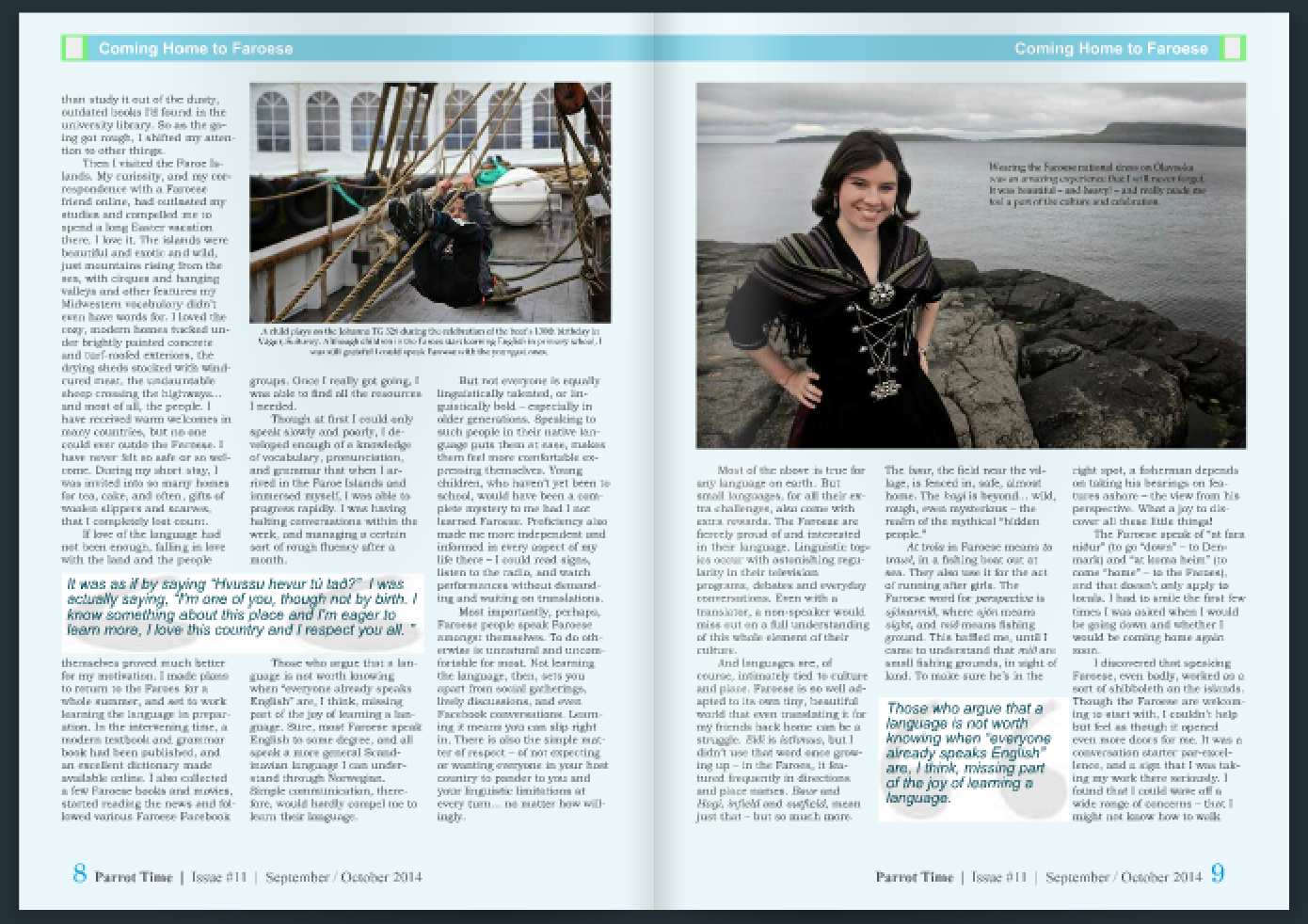
From my article “Coming Home to Faroese” in Parrot Time’s special Faroe Islands issue.
“Coming Home to Faroese” was my main feature story for the magazine. By exploring the richness that learning Faroese has brought to my life, I wrote about the challenges and rewards of learning a language with a small number of speakers. Here’s an excerpt:
“I remember how it felt to speak Faroese down in Copenhagen, to navigate through the crowded city and yet feel as if I had never left the islands when I heard the language I had learned to love so well. The Danes and other foreigners that passed were none the wiser that something didn’t add up, that I was an imposter, that I didn’t belong. In a way I did. In that moment, I felt I could just glimpse, just taste, that feeling of being a part of something… smaller. Something more intimate. Of what it meant to know just from a language that you were home.”
Now that I have been in the Faroe Islands for a few weeks, I have gotten started with my research interviews. I plan to talk to several Faroe Islanders of varying ages, genders, and places of residence about how the Faroe Islands are represented to foreigners through various media channels, and how they feel about those representations.
So far, I have conducted three formal interviews and more than a dozen informal conversations on this topic. One trend that has started to suggest itself is that the older interviewees have been more positive about representations of the Faroe Islands than the younger interviewees, even suggesting that the tourism imagery shows the islands in an unrealistically good light, while the younger interviewees seemed more bitter about anti-whaling sentiment and outdated representations.
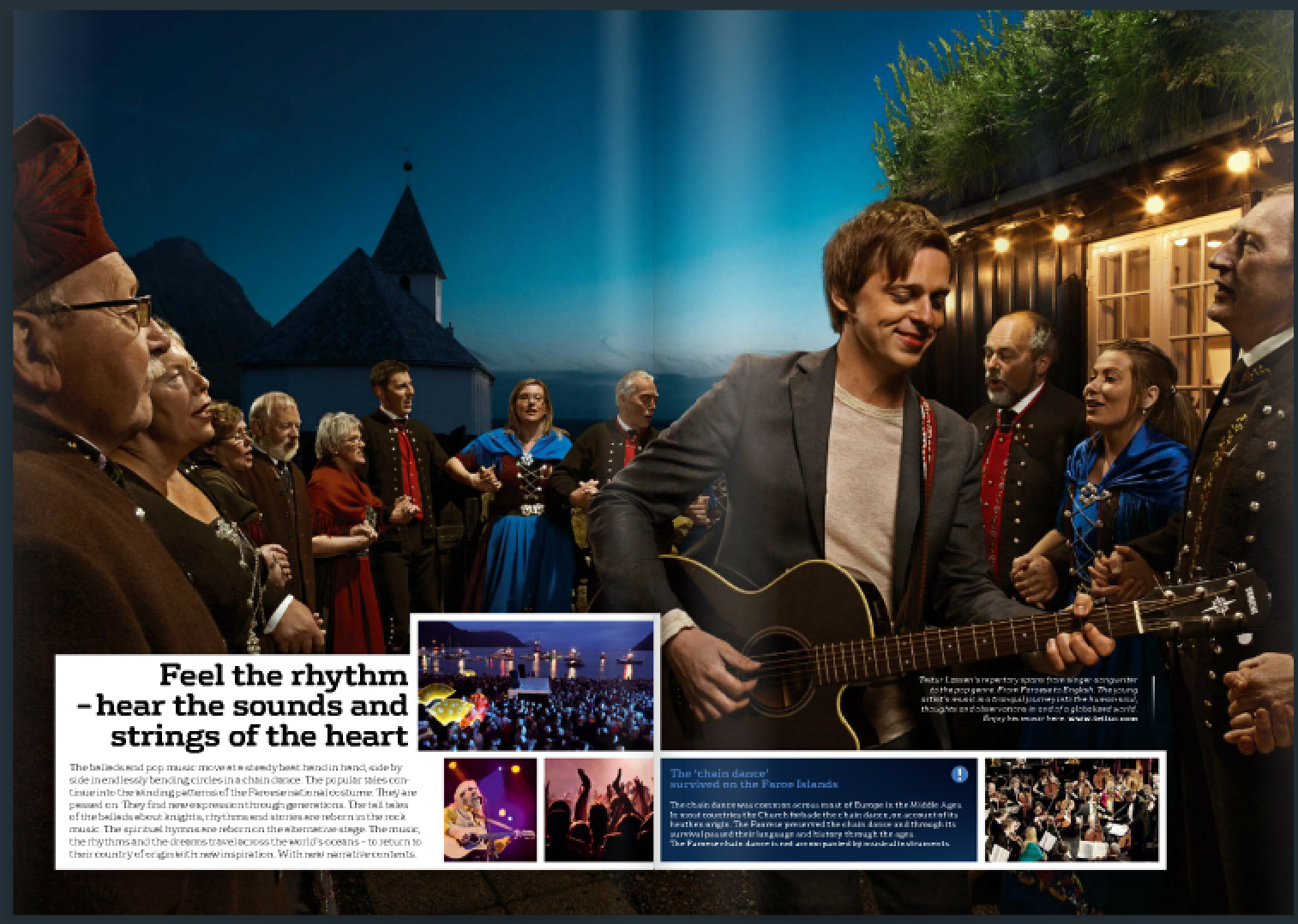
A two-page spread from Visit Faroe Islands’ new tourism booklets. This is one of the images I ask respondents to consider in the final part of the interview.
One amusing wrinkle in the interviews has been that many respondents have recognized people they know in the example media I’m presenting to them. In my very first interview, I showed part of a video, and my interviewee asked me if I would like him to introduce me to the people speaking in the video. In another interview, when I showed the above photo of the Faroese ring dance, the interviewee told me that she recognized “almost everyone” in the photograph, as they were all from Klaksvík!
When I was planning the interviews, the possible frames I felt that I had seen in representations of the Faroe Islands were exotification (through emphasis on the traditional ways of life or the remote, wild natural conditions), trivialization (due to the nation’s small size), and conflict (presenting the Faroe Islands as backwards, especially in regards to the controversial grindadráp).
So far, no one has mentioned the trivialization frame, except to say that many people are not aware of the Faroe Islands at all. One man told me an anecdote in which he was travelling and tried to explain where he was from to some people who had never heard of the Faroes. He said that it was in between Scotland and Iceland, and they insisted that no such country existed. He looked around for a map of Europe, and when he found one, the map itself was missing the Faroe Islands! He had to find a second map to prove that he was, indeed, from a real place.
Here are the main points I’ve heard so far about depictions of the Faroe Islands:
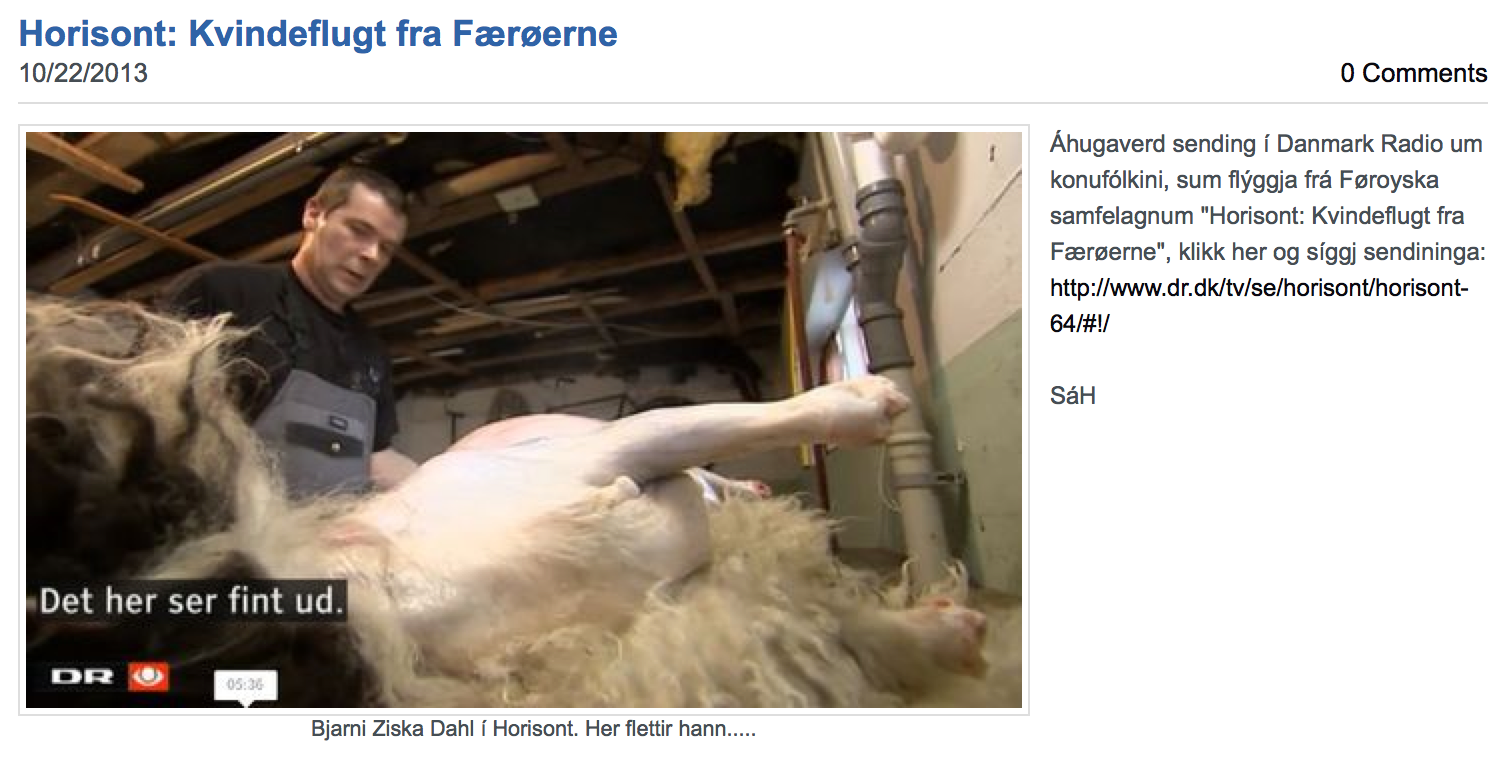
A screenshot and description of the Danish tv documentary, “Kvindeflugt fra Færoerne,” which is about the gender disparity in the Faroe Islands. This is one of the images I ask respondents to consider in the final part of the interview.
– They focus more on old traditions, such as the ring dance, and less on growing, current trends like modern music and cuisine.
– They are antiquated, and haven’t caught up with the changes of the last 10-30 years.
– They imply that everyone in the Faroes is a sheep farmer or a fisherman.
– They play down or ignore the existence of modern institutions like hospitals, shops, and the University.
– Information about the Grindadráp is filled with inaccurate claims, such as that the pilot whales are endangered or killed for fun.
– They have beautiful photosand descriptions of the unique Faroese nature.
– However, they could be painting an unrealistic picture of good weather and endlessly clear skies, conditions which are rare in the Faroes though they do occur.
– They ignore the winter almost completely in favor of coverage of the brief tourism season (June-August).
– They are concerned that tourists might not understand that the Faroese weather is uncertain and changeable, and that everything in the Faroes is expensive.
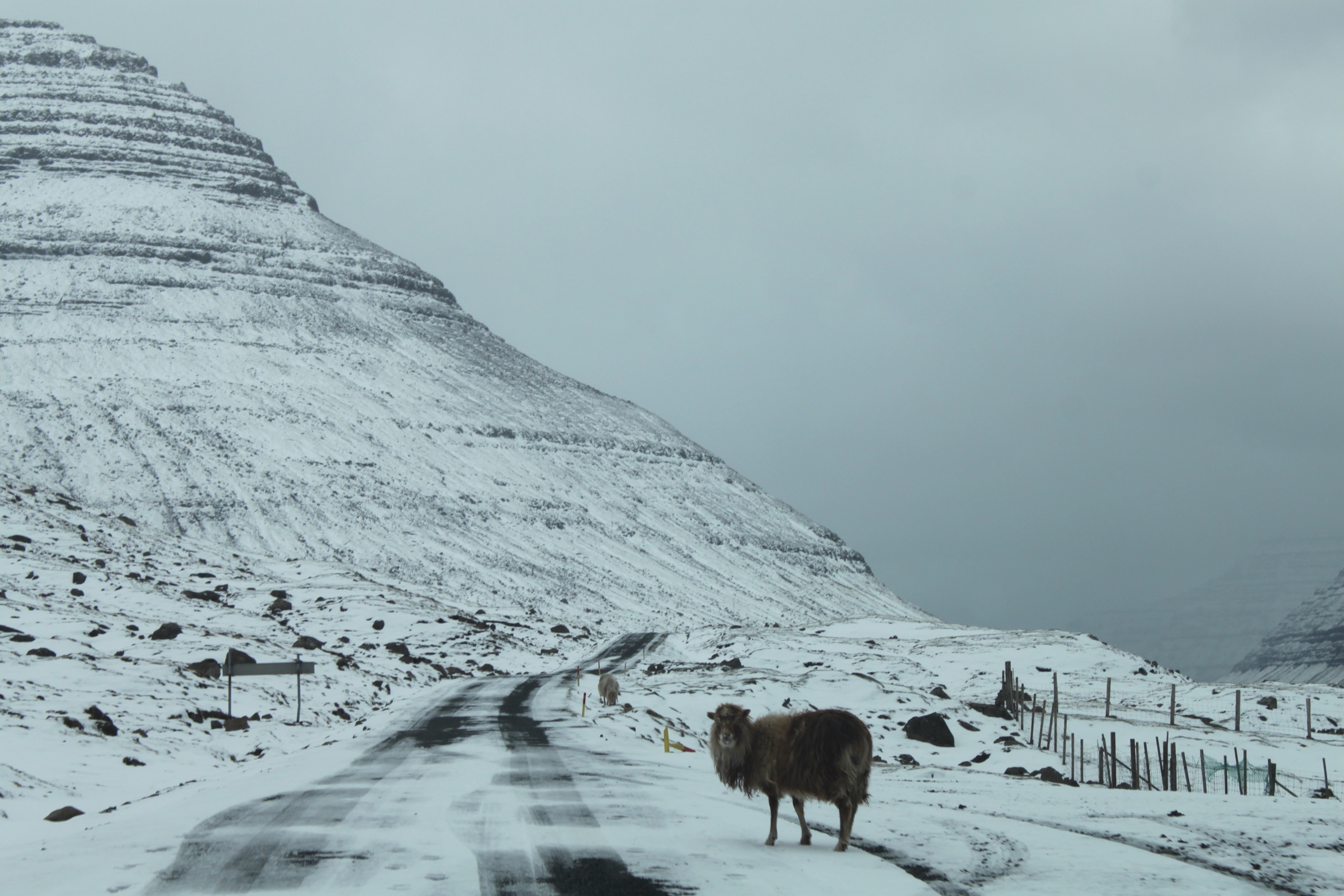
A sheep walking on the road leading to the village of Múli. This is one of the images I ask respondents to consider in the final part of the interview.
So far, one of the most intriguing things to come up in an interview was one woman’s suggestion that many of the problems she saw in representations of the Faroe Islands had the same problematic root — that foreigners almost never travel to the islands in the winter. Not only does that ignore more than half of the year in the Faroes, she thinks the long, dark, stormy winter has a huge effect on the Faroese culture, and that, without understanding that, it’s impossible to explain the Faroese mentality or perspective on a wide range of issues.
My first taste of anything Faroese was the language itself, when a friend sent me Týr’s Ormurin Langi, a heavy-metal recording of an old Faroese ballad, almost a decade ago. Later, I would come to know the landscapes, the culture, and the people as well, but part of me fell in love with just the words themselves.
In a way, that’s very fitting. Language is a hugely important part of cultural and national identity. You’ll find it at the heart of many a nationalistic movement. The Faroese language and its use played an important role in the movement towards Faroese autonomy, and continues to be a factor in negotiating distance from Denmark and concepts of what the Faroe Islands should be today.
The Faroese language is very important to most Faroese, for whom it is their mother tongue, inextricably tied to the culture and proof of their need for independent recognition. In “Cultural Rhapsody in Shift,” Faroese Anthropologist Firouz Gaini writes that “the language, first and foremost as a semantic system and an oral tradition, has dominated the scene and been widely recognized as the jewel of the Faroese culture.”
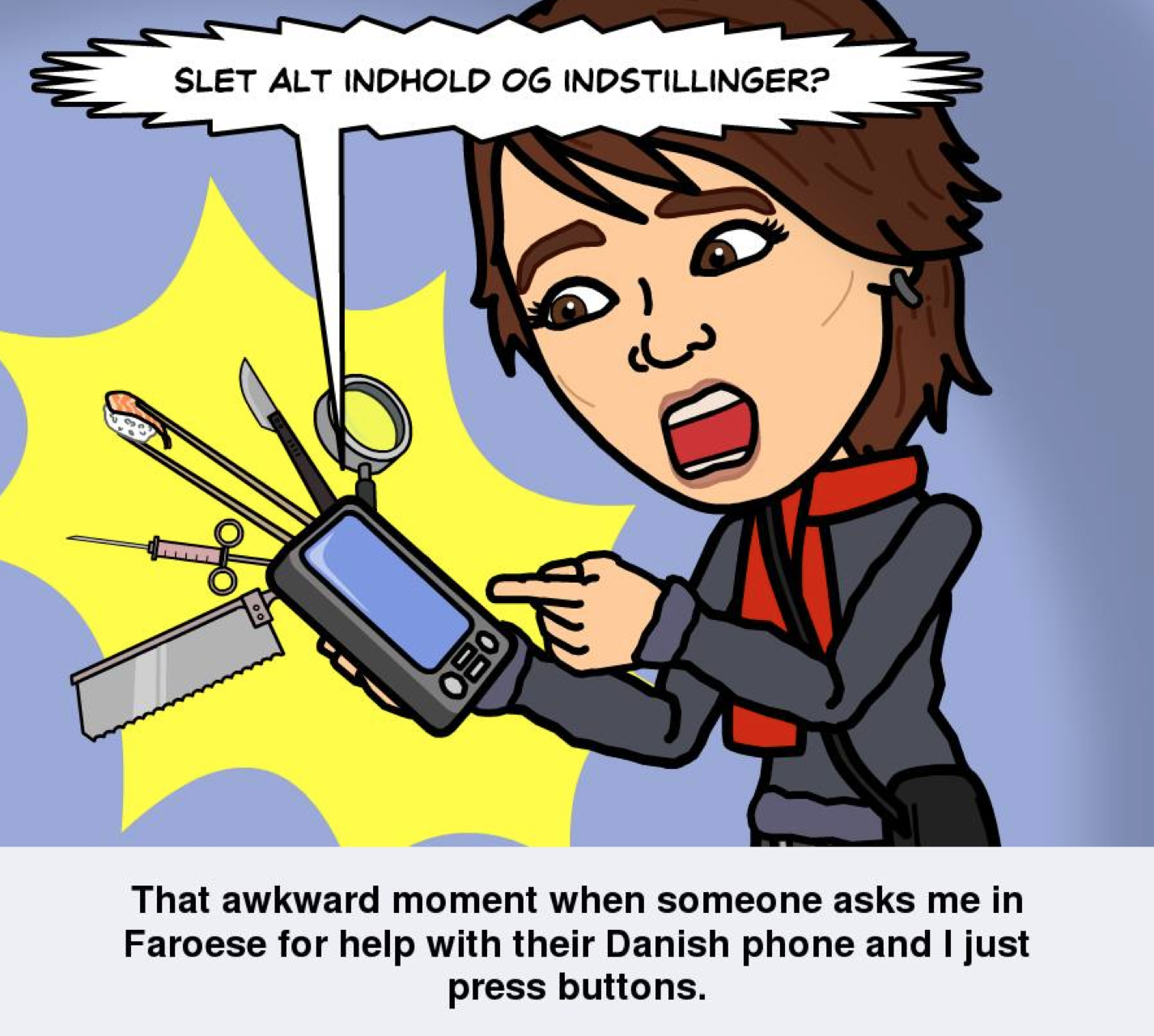
Until the mid-20th century, Danish was used in official matters, education, literature, and religious institutions. Even today, because of the size of the community, a huge variety of imported products and media are not translated into Faroese. The Faroese TV station, when it runs out of Faroese material, switches to whatever it can get from Danish, Icelandic, Norwegian and American programming, generally subtitling in Danish if at all. The cell phones are Danish, and if you want to text in Faroese you’ll have to turn off the auto-correct and switch over to the Icelandic keyboard every time you need the letter ð (edh). Despite the huge push to translate all sorts of things from all parts of life, children still have to use many Danish textbooks and sometimes even take their exams in Danish. At a minimum, the Faroese are bilingual with Faroese and a local variety of Danish called Gøtudanskt, but many also speak good Danish, are trilingual with English, and even multilingual with other foreign languages on top of that.
One could spend twenty minutes just explaining the history of Faroese in conjunction with the other Scandinavian languages, but, in an attempt to make things brief, Faroese is descended from Old Norse, just like Icelandic and Norwegian. Danish and Swedish developed in a rather different direction, but Danish then had a huge effect on Faroese and especially Norwegian when they were under Danish rule. The result is that Faroese and Norwegian can be considered the most central of all Scandinavian languages, with Faroese retaining more grammatical complexity and similarity to Icelandic and Old Norse. The Faroese are in fact the best in the region at understanding all of the others.
Faroese is a highly inflected, highly irregular language with an inconsistently phonetic writing system.
When I say Faroese is highly inflected, I mean that they love “bending” words – or conjugating their verbs and declining their nouns. Verbs take different forms depending on who does them and when, and nouns are even worse. There are three different noun “cases” – Nominative, Accusative, and Dative, depending on whether the noun is acting as the subject, object, or direct object or according to its place within a certain idiomatic expression. Nouns come in three genders, and within each gender there are several possibilities for how the words within that gender can be bent. Then, of course, you also have to think about definite vs. indefinite nouns, because the definite marker goes at the end of the word and affects the bending. If you’re keeping track, that means each noun has 12 forms – not counting four genitive ones which are now rarely used.
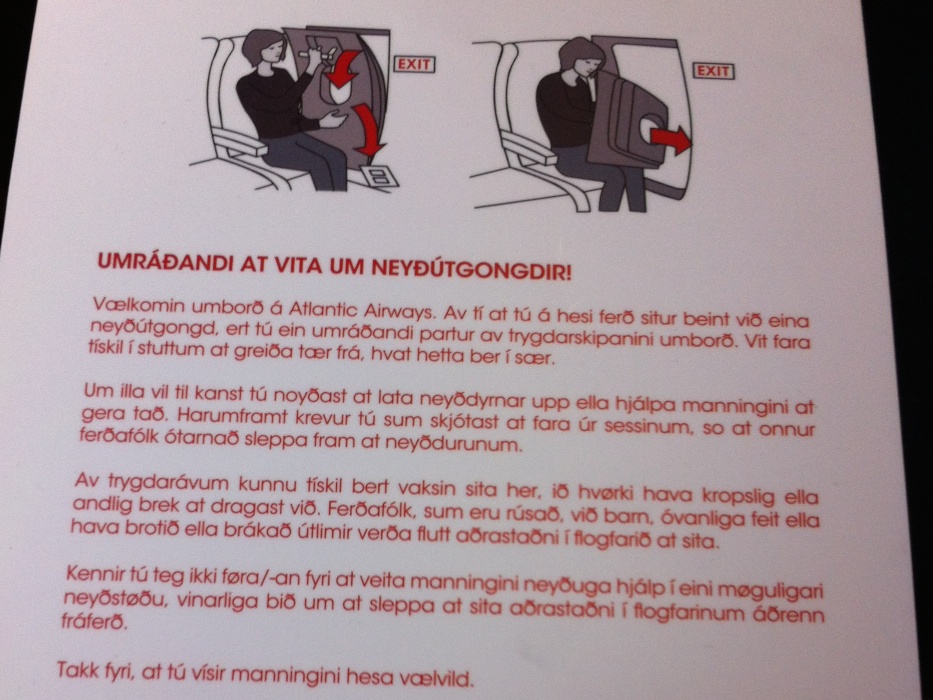
Emergency Exit Row instructions in Faroese on at Atlantic Airways flight.
When I say Faroese is irregular, I mean that, despite all of these rules, you’ll find almost as many words that vary from the rules in at least some small way as you will words that follow them exactly. You’ll also find alternative ways to say all sorts of things – head, for example, can be høvur or høvd, or even heysur or knokkur.
Faroese also has some rare and strange vowel sounds, much as English does. This has been really hard for me to get used to, even though it’s not that different from my native language, simply because I’ve gotten so used to purer, simpler sounds in every other language I’ve learned. So you have to get used to that sort of irregularity.
The Faroese writing system is one of the biggest headaches for both native and foreign learners. I’m constantly asked here if I can also write Faroese. It would be very easy for someone learning the language by ear here to be completely illiterate. The relationship between the letters and the sounds is quite irregular, like in English or French, and takes a lot of getting used to. The reason for this is that when the written language was developed, and quite late at that (1854), the primary goal was not phonetic fidelity but rather etymological clarity. The written language is so clear about its roots that I can basically read Icelandic and Old Norse now, even though the spoken language has diverged greatly since that time. A secondary advantage of this writing system is that it avoided privileging any specific Faroese dialect (yes, that’s right – in a nation of less than 50,000 people, there are several dialects). That latter is what I’ve been told, anyway. From where I’m standing, it seems to me that that’s true only because the written language is so out of touch that it works equally poorly, and thus equally well, with every spoken dialect.
To give just one – although admittedly particularly egregious – example of the spelling nonsense, consider the letter ð (edh). Students of linguistic notation, Old English, or Icelandic will think they know this friendly character. It normally makes a voiced th sound (like in “then” or “there.”) Not in Faroese, though. In Faroese, it means whatever it feels like. Usually that’s some sort of semi-vocalic glide, like a W, V, or Y. But sometimes it’s a G. In exactly one word, it’s a D. I only wish I were joking.
“Gjógv” is the name for this village and the Faroese word for Gorge. Think it’s pronounced Jogv or Gyoegv? Think again. It’s more like Jeggv!
All of this makes Faroese quite a bit harder than the average Indo-European language to learn. But I also find it also incredibly rewarding because it has such a tight and fascinating connection with the culture here. It’s lovely to see how much people value and take an interest in their own language — that enthusiasm makes the learning process, even if slow and slightly painful at times, an adventure I’m happy to embark on.
I have now been in the Faroe Islands for just over a week. It feels like much longer (in the best possible way). Though I am just getting started with my journalism work and research, it’s been a very busy week as I’ve adapted to my new lifestyle.
My situation could not be any better. I am staying with an incredibly friendly family who include me in all of their activities and love helping me to learn the Faroese language and the culture. A lot of my time this week has been spent doing things with them, from making a late mother’s day breakfast to going to the extended family knitting club. I have been settling in to the routines of the house, and just like anyone else, I wash dishes, cook meals and take out the dog, Lolli. Even during the day, when most of the others are working, I am never lonely. Eight people live in this house, and other relatives and friends drop by regularly as well, coming and going at all hours.
My bedroom and puppy for the summer!
My village, Norðragøta, is a beautiful and very old village with a central location on the main bus route and road between the two biggest Faroese towns, Tórshavn and Klaksvík. Though I ended up here by chance, I couldn’t have picked a better place to live.
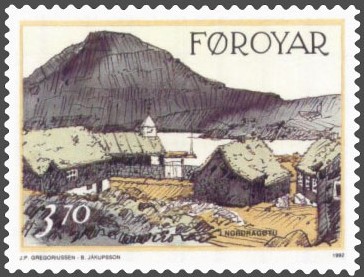
A Faroese Stamp featuring Húsini hjá Peri, the old part of Norðragøta with its lovely turf roofs.
Norðragøta has a population of 550, and the larger “Gøta” area, which comprises Norðragøta as well as Gøtueiði, Gøtugjógv and Syðrugøta, is home to just over 1,000. By Faroese terms, that’s right in the middle — not a booming metropolis like the capital (population 12,500), nor one of the many tiny, remote villages. I can walk to a small grocery store, a gas station, a soccer stadium, a fairly large and modern church and several other commodities, but the village still has a friendly and relaxed bucolic feeling.
Horses and mountains from my window in Norðragøta.
Wherever you are, you can hear the crying of the gulls and the bleating of the sheep. From my window, I can almost always see children playing in the stream, dogs walking around freely on the roads and even a few horses, who are allowed to graze in alternating yards and fields and confined only by portable rope fences that are moved every few days.
The Faroe Islands in Vertical: Here you can quickly see the difference between the Bøur, or infield, and the Hagi, or outfield, where sheep are kept in different seasons.
Norðragøta is quite a typical Faroese village situated, like everything in the Faroes, on narrow bits of almost-flat land between the mountains and the sea. Things are arranged almost vertically here — the sea; the beach and the harbour; the fish factory; the houses and businesses; the infield; the outfield; the cliffs; the mountain-top fog; the sky — are all stacked like layers of coloured sand in a jar.
Gøta also has a few special distinctions. It is the home of Eivør Pálsdóttir, one of the most famous Faroese singers, and the annual G! Music Festival. Gøtuvík is one of the largest bays in the Faroes, and the Stóragjógv cleft that empties into it is the largest such canyon on the islands.
Traditional Faroese church in Norðragøta, complete with turf roof.
Gøta also features prominently in the Faroe Islander’s Saga, or Færeyingasaga, as one of the main characters, the heathen Viking chief, Tróndur í Gøtu, had his farm right here! In the oldest part of Norðragøta, there are several turf-roofed houses, a 200-year-old traditional Faroese church, and a living-history museum at the old house Blásastova, where my host family’s ancestors lived. This is one of the best places in the islands for visitors to experience what Faroese village life was like not so long ago.
Norðragøta already feels like home to me. I’m very excited to spend the summer here!
En route to the Faroe Islands, I spent several days in the Norwegian coastal city of Bergen. One does not simply fly into the Faroe Islands, after all. Although Atlantic Airways (the Faroese national airline) is expanding its services pretty quickly, coming from America you still need to connect in one of a handful of European cities. You’ll have to book the flights separately, and, with flights in and out of the Faroes frequently delayed (sometimes for days) its good to have some buffer time in between. That gave me the perfect opportunity for a short stay in Bergen, where I studied abroad in 2012. The plan was perfect — I could stay with friends and even attend the 200th Jubilee celebration of Norwegian Constitution Day, or Syttende Mai.
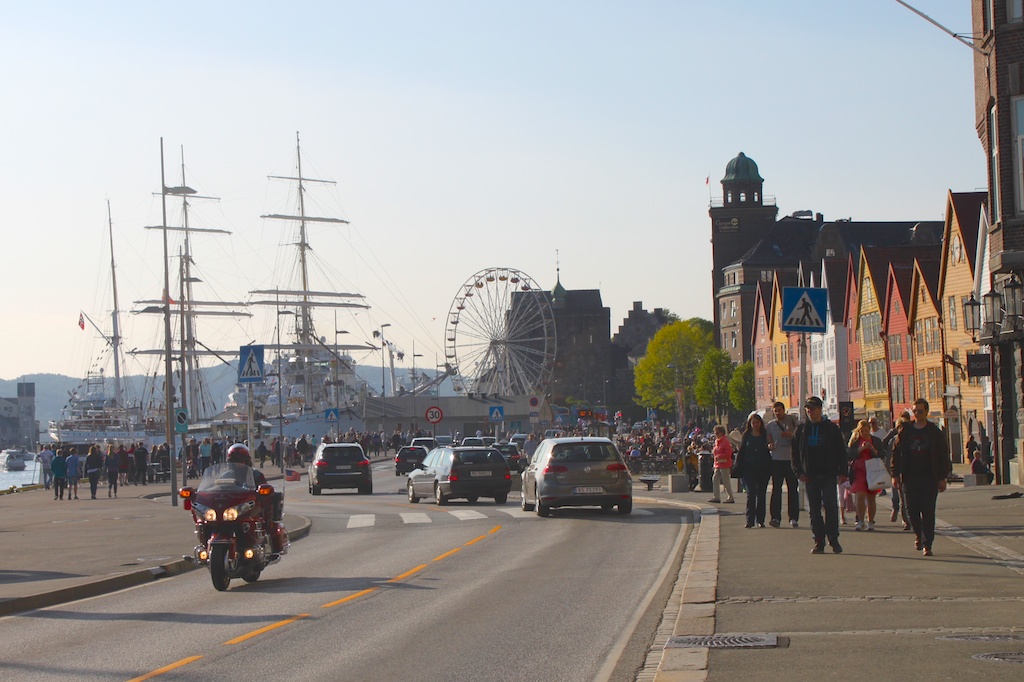
From right to left: The famous tall-ship Statsraad Lehmkuhl, a Ferris Wheel for the Bicentennial celebrations, the Haakonshalle and Rosenkrantz Torn medieval buildings, and Bergen’s historic wooden wharf (Bryggen).
Aside from convenience and pleasure, there was also something romantic about the idea of entering the Faroe Islands through Bergen. Norway, and especially Bergen, have long had a tight connection to the islands, which they controlled during Viking and Hanseatic times. When the Danes took over Norway, they took the Faroes as well — and kept them when Norway was handed over first to the Swedes and then, finally, to the Norwegians themselves. Copenhagen long ago replaced Bergen as the “capital across the water” where Faroese goods were traded and religious and political authorities reported. But Norway and the Faroe Islands continue to resemble and remember each other in many ways.
Unlike in the rest of the world — and even in the rest of Europe — the Faroes are well known in Norway. Some Norwegians have even been there. The blank stares mentions of the Faroes elicited for me in the United States were replaced with a wide variety of reactions — “Wow, you’ll love it!” “How intriguing.” “What a crazy place…” “I had a Faroese friend once.” “I love Faroese music.” “I’m applying for a job there.” “I’ve always wanted to go there!” “Their language is so strange, it’s like you can almost understand it, but not quite…”
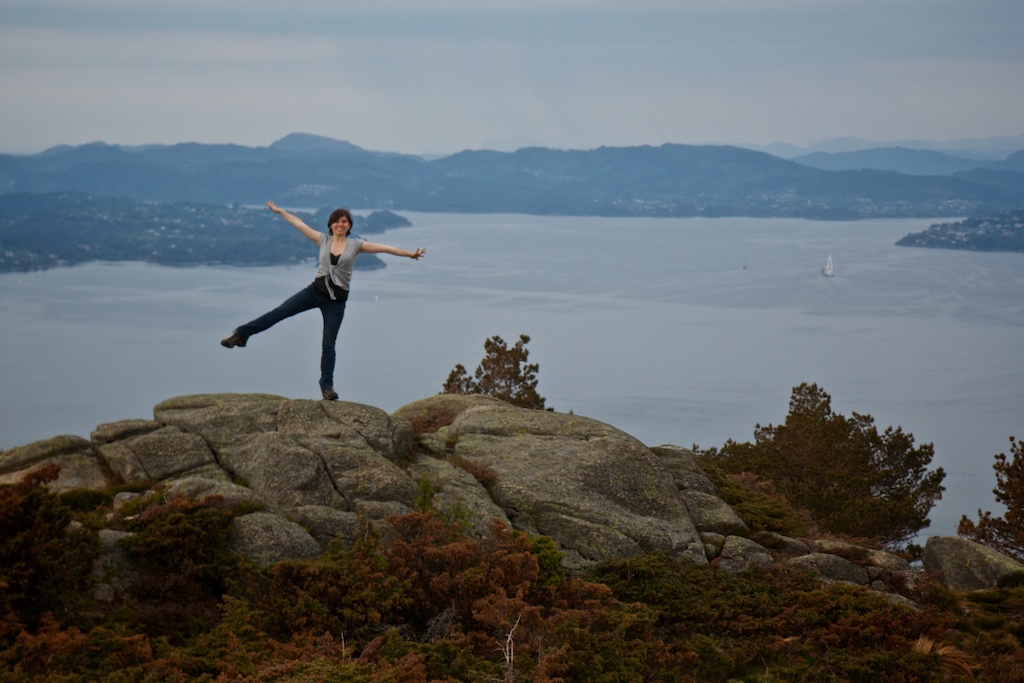
Rising high over the sea on Damsgårdsfjell!
Hiking on Mt. Ulriken, high above the city.
In many ways, Bergen was a good halfway point between where I was coming from and where I was going. A good place to acclimatise. The mountains and the sea, the rain and cool summer weather, the wool sweaters and smell of fish — these I would find in the Faroes as well. The size of the bustling city, the birch and oak and pine — these I would still have to leave behind. Norwegian was harder on my brain and tongue than my native English, but much easier and more familiar than the more-inflected and less-phonetic Faroese.
Fishing and picnicking on Mt. Sandviken.
I drank deeply of the pure mountain water I had missed so much. I walked so far that blisters broke through my tender flatland feet. I saw friends I had missed for many months, meeting them in bars and cafes, by lakes up on the fells, in cozy homes where the familiar smell of wet wood and the warmth of heated floors nearly brought me to nostalgic tears.
The Syttende Mai Parade
Syttende Mai was a day to remember. We gathered for the traditional holiday breakfast, with puddings and fenelår sausage and champagne, and walked down to the city along with thousands of Norwegians who had gathered in their Sunday best or beautiful Bunads, the Norwegian national dress that varies spectacularly and colorfully from region to region.
Spectators at the Syttende Mai Parade
We wandered blissfully from the parade to a cozy cafe packed tight with the festive air, to the statue of Ivar Aasen to celebrate the linguistic diversity of Norway, to the city’s oldest student bar up on the cliff, down to the wharf for ice cream, back to Årstad, on the other side of the harbor, to grill as the afternoon light shifted into a long, light Nordic evening. And we sang about Norway, in Nynorsk and in Bokmål, sometimes stomping the deck so hard that I was afraid the old boards would break.
After a short break when the French girls sang their anthem and I sang an Ozark ballad (I decided on Matty Groves), my friend Kurt turned to me and sang,
“Vilja tær hoyra kvæði mítt?”
The first words to Ormurin Langi — one of the most famous Faroese kvæði. “Do you want to hear my ballad?”
I answered,
Vilja tær orðum trúgva, um hann Ólav Trygvason, hagar skal ríman snúgva.
Glymur dansur í høll, dans sláið í ring: Glaðir ríða Noregsmenn til Hildar ting.
Now that was good fun! Here were cultural roots that ran deeper than the sundering sea. I pulled up the lyrics on my phone so we could all sing along, some tripping over the orthography here and there or interrupting to say, “That’s just like an old word from my region! Like something my grandfather would say!”
In English, the lyrics mean something like this:
Will you believe the words, About Olav Tryggvasson, Here’s how the rhyme revolves.
Raucous dance in the Hall, Dance, form a ring, Gladly ride Norway’s men, To Hild’s War Gathering.
Singing Anthems, Ballads, and Kvæði
At some point, an exchange student came by to ask Kurt what was going on.
“This is a song that they sing on the Faroe Islands,” he told him. “That’s a little group of islands way out in the sea between here and Iceland. We like the way they sing. And this song is about a Norwegian king; they celebrate him on their national day. This makes us very happy.”









 Adventures in the Land of Maybe