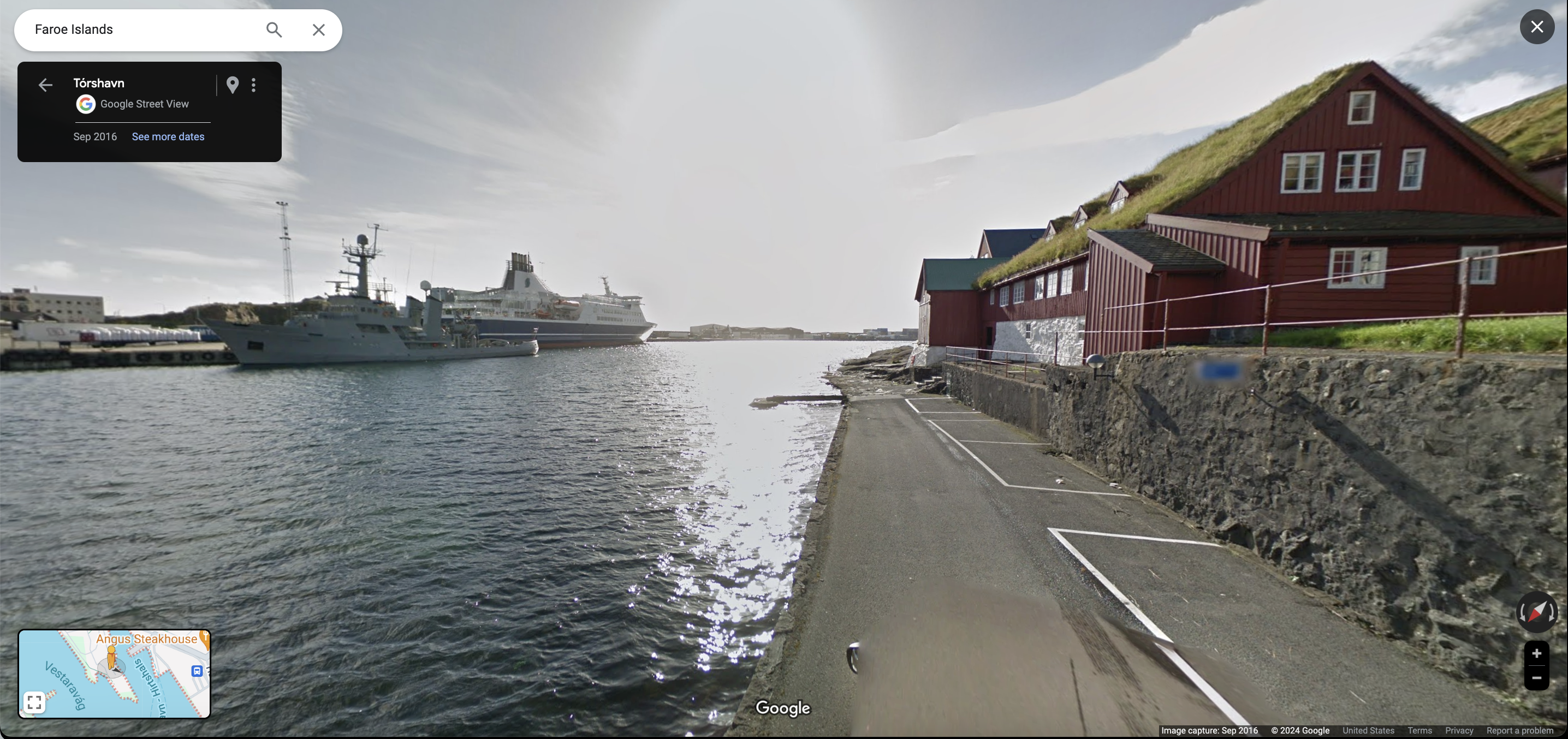
As of today, June 27th, 2024, the Faroese language has been added to Google Translate, one of some 100 new languages! The Faroe road network has also been accessible on Google Street View for several years now.
When I first became interested in the Faroes, way back in 2006-2009, such a robust web presence would have been hard to imagine. But some fifteen years and and two brilliant marketing campaigns by Visit Faroe Islands later, the islands and their language are fully online.
From Sheep View 360 to Google Street View
For Sheep View 360, launched in 2016, several sheep were fitted with cameras and sent out to capture stunning views… and the attention of Google. The campaign was wildly successful on every front. The story captured the attention of media outlets worldwide, showcasing the islands’ beauty to millions of potential visitors. According to a Washington Post Article, ‘How sheep with cameras got some tiny islands onto Google Street View‘, Google called the project “shear brilliance” and assisted with the non-traditional mapping efforts before sending out the Google Street View Van the next year.
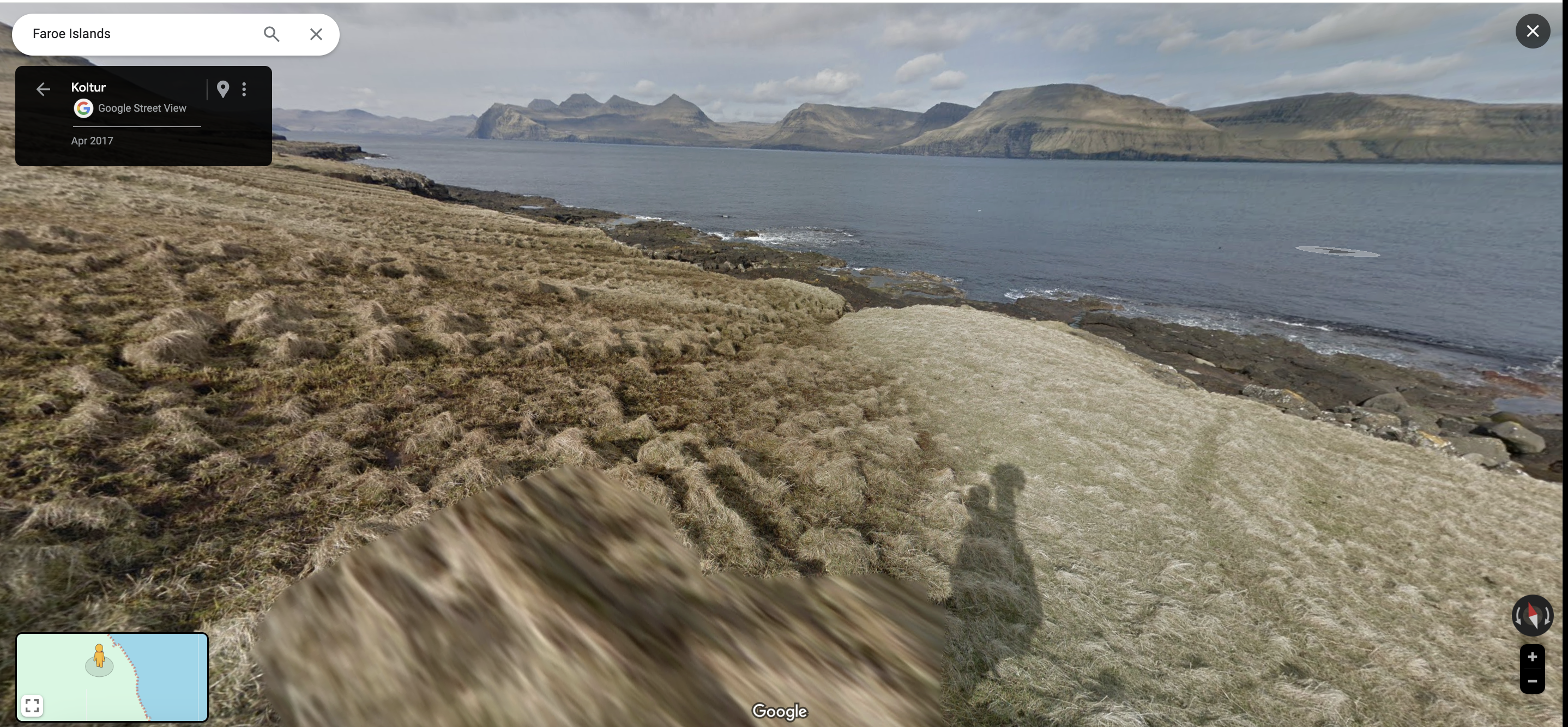
Today, nearly the entire country has been mapped by Google Street View. You can explore the old area of Tórshavn, the Faroese capital, as well as the twists and corners of tiny villages. It seems the Google truck made it everywhere you can take a vehicle, and then some — even the remote islands of Koltur and Fugloy have ‘street view’ paths you can follow through the mountains.
From Faroe Islands Translate to Faroese on Google Translate
Today’s big news is that Faroese is now available on Google Translate!
This also followed a Visit Faroe Islands initiative, Faroe Islands Translate, back in 2017, in which Faroese people could upload recordings in response to translation requests.
I tried out Google Translate for Faroese this morning. My test of Faroese > English seemed quite accurate:
On the other hand, when I tried English > Faroese, I got some very Icelandic looking nonsense:
Strangely, adding in the comma that should properly be in the English sentence seemed to return a much better result:
Well, it’s only the first day, and I’m sure there are still some bugs to be worked out.
Once they are, it will be interesting to see how having a free translation service for Faroese changes the position of the language, particularly online. Until now, for example, there has essentially been no spam in Faroese. If you saw a message in Faroese, you could essentially assume it was genuine and that the person writing it actually knew the language. This will no longer necessarily be the case going forward.
At any rate, this is an exciting day for the many Faroese people who looked forward to being able to use Google services for their own country and language!
It’s been eighteen years since I first heard of the Faroe Islands. Sixteen years since I found a Faroese friend online and started trying to learn the language. Twelve years since that first magical, snowy visit.
And it’s been ten years — a full decade, somehow! — since I spent a whole summer on the islands, learning Faroese and working on my graduate project for the Missouri School of Journalism.
My life has changed significantly in the intervening years. I’m now a World Language teacher, and live with my husband in Washington, D.C.
And I still feel a powerful connection to the Faroe Islands.
I’ve returned several times, seven magical summers: each a happy return, each somehow a little different. I’ve made unforgettable memories at ‘home’ in Gøta and Tórshavn, and gone on marvellous adventures to some of the most remote corners of the islands. One year, my penpal came along from Finland; another year, a dear old friend from grade school. Most recently, my husband finally saw the place I’ve been telling him about for years!
My husband, Nash, and I on a 2022 visit to the Faroe Islands.
The Faroes too have changed, as everything on Earth must.
It’s 2024, and in many ways, the future has come to the Faroes. Atlantic Airways runs direct flights between New York and the Faroe Islands. The new Hilton Garden Inn in Tórshavn has more than 100 fancy guest rooms.
Eysturoyartunnilin opened in 2020 as the world’s second-longest sub-sea road tunnel, cutting the drive between Tórshavn and Runavík, once a winding hour-plus of following the fjords, to a snappy 20 minute short-cut under the sea. The tunnel even features the world’s first sub-sea roundabout, allowing drivers to exit in Strendur on the other side of Skálafjørður.
As of 2023, Sandoyartunnilin has brought the island of Sandoy into the “Faroese Mainland” that can be driven without a ferry crossing. If all goes well, Sandoy will be a stepping stone for the Suðuroyartunnil that will add Suðuroy, the southernmost and last large unconnected island, to the main Faroese road network. Some proposals even include a quick stop in Skúvoy (population 40) which is among the smallest and most remote islands in the archipelago.
In more personal news, my host family has grown, by three fantastic children, and recently come to visit me in the United States!
My ‘home village’ of Gøta has a new playground, beloved by my Faroese niece-of-sorts. The town-hall, stone picnic table, and riverside path were also pleasant additions to the village landscape. The town-hall has won architectural awards for blending Faroese tradition with modern Nordic design… but it’s also broken the sight-lines down the river to the fjord. And the new footbridge crosses the stream just where I used to leap from stone to stone, where I took a low-vantage-point photo I submitted as part of my graduate portfolio. I can’t take that photo again, nor cross over those stones… but that’s just how life goes. No doubt there were people in the Faroes who mourned the unspoiled mountains when they put in the roads that are now an essential part of life.
More foreigners than ever are now visiting the Faroes. It’s impossible not to have a whirlwind of emotions about that, especially when I’m quite complicit — I’ve encouraged roughly everyone I’ve met in the last decade to travel there. The tourism boom is good for the economy, and for certain facets of the culture. Other traditions are threatened. Debates about access to the Faroese nature, almost all of which is privately held, have pitted neighbors against each other, where once the feeling was that one could walk in the hagi (outfield) without asking any special permission.
But the Faroe Islands are still Faroese, and I remain utterly enchanted by this strange and wonderful little nation.
As I write this, a strike by multiple labor unions has all of the islands in its grip. The fresh food ran out almost immediately, followed by the gas and diesel, and now even the potatoes, pasta, and frozen food is running low. There’s still dairy though, and fish, and fresh pilot whale from a recent grindadráp in Hvannasund.
Plus ça change, plus c’est la même chose —
Jú meira tað broytist, jú meira verður tað tað sama.
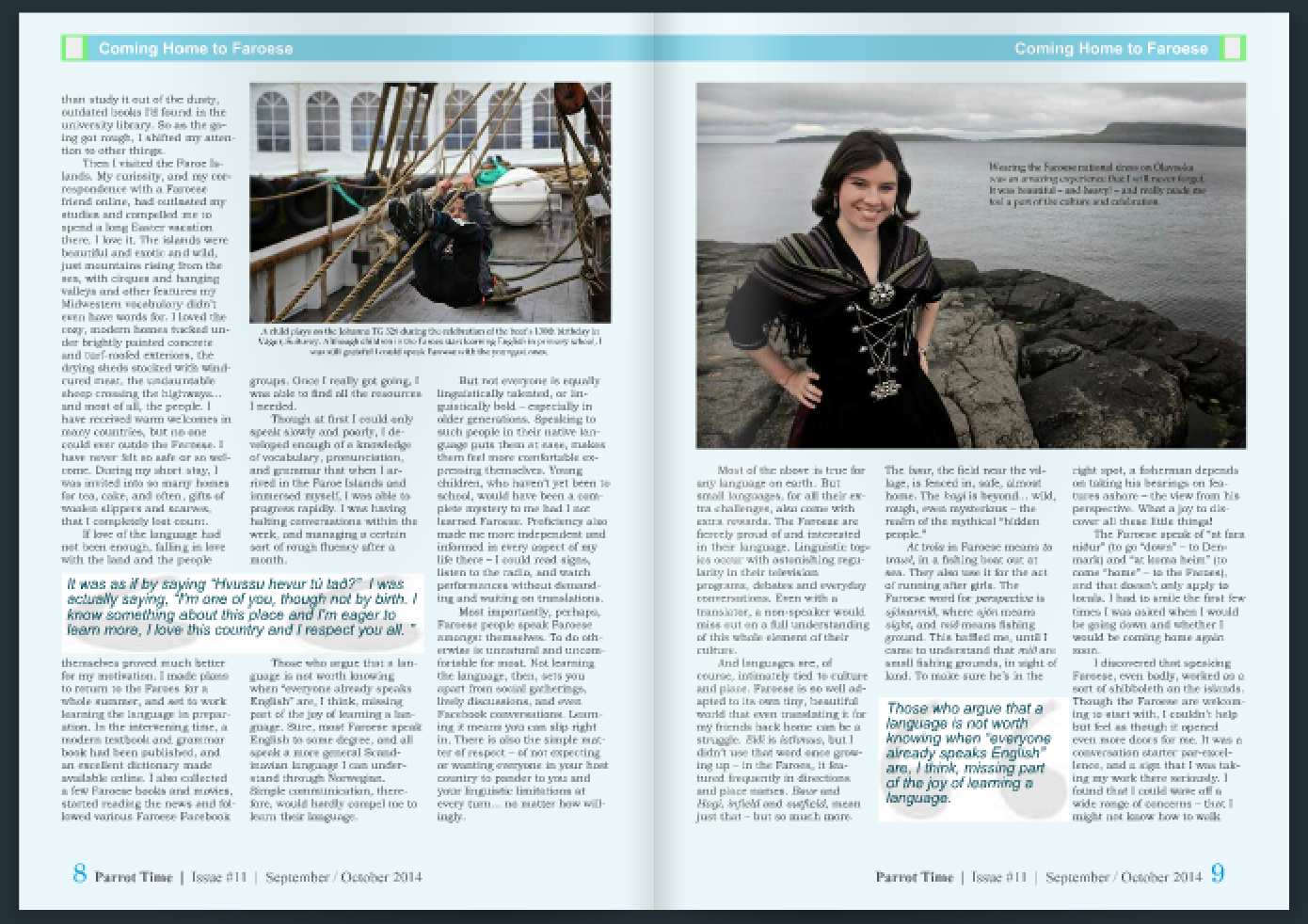
Parrot Time is a linguistic and cultural emagazine published bimonthly by the Parleremo language learning community. The magazine’s editor-in-chief, Erik Zidowecki, contacted me based on our conversations about the Faroe Islands to ask whether I would be interested in helping him put together a special issue focusing on Faroese topics. Naturally, I was very excited to work on the project. With the help of four Faroe Islanders, we published eleven articles on subjects ranging from summer festivals on the islands and the new feature film Ludo to the presence of Danish in Faroese life and the Faroese perspective on the whaling controversy. I’m very happy with the way the magazine came together with such a wide variety of pieces and beautiful photographs.
From my article “Coming Home to Faroese” in Parrot Time’s special Faroe Islands issue.
“Coming Home to Faroese” was my main feature story for the magazine. By exploring the richness that learning Faroese has brought to my life, I wrote about the challenges and rewards of learning a language with a small number of speakers. Here’s an excerpt:
“I remember how it felt to speak Faroese down in Copenhagen, to navigate through the crowded city and yet feel as if I had never left the islands when I heard the language I had learned to love so well. The Danes and other foreigners that passed were none the wiser that something didn’t add up, that I was an imposter, that I didn’t belong. In a way I did. In that moment, I felt I could just glimpse, just taste, that feeling of being a part of something… smaller. Something more intimate. Of what it meant to know just from a language that you were home.”
High Summer has come to the Faroe Islands. The yellow buttercups and marsh marigolds have been joined by white clover, purple ragged robin and lacy umbels of angelica. The days are at their longest, the hills at their greenest, the weather at its finest — but keep calm, we’re still talking Faroese standards.
The Faroese version of a “Beach Day” at the G! Festival — not exactly for the Miami crowd!
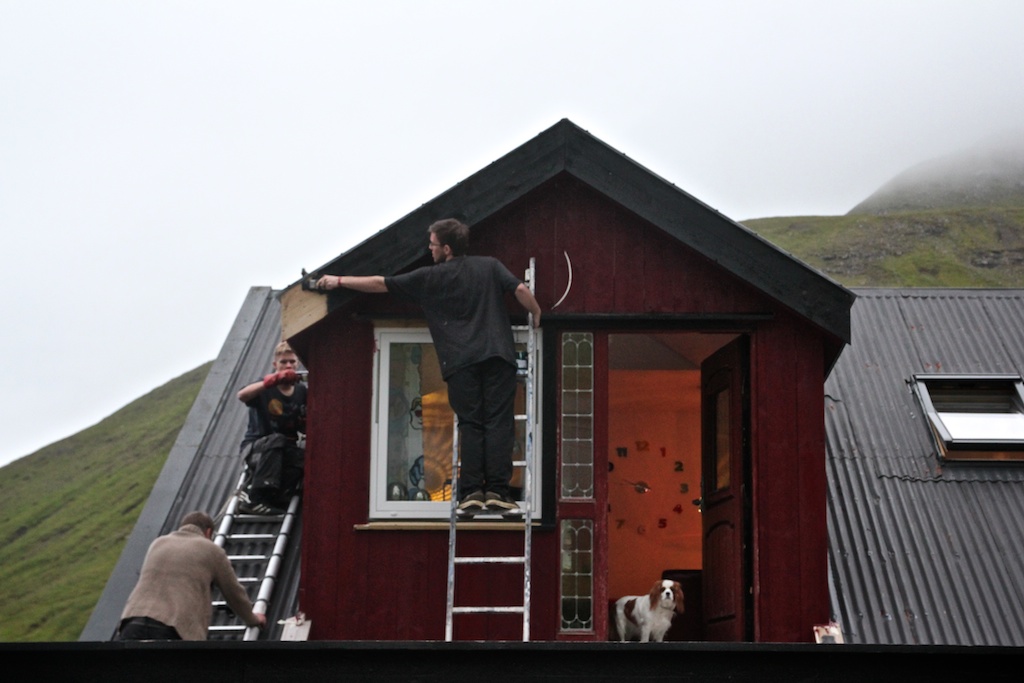
Yesterday the G! Festival began in earnest, my lovely host family finished painting the upstairs and the outside furniture, and Norðragøta was loud with the sounds of seagulls and drunk festival-goers, our house full of guests stuffing themselves on bollar and home-made rhubarb jam, and hundreds of sheep baaaa-ing as they were herded down off of the mountain Tyril to be sheared.
Painting houses in the summer weather.
As Jonhedin Herason Trondheim told me at a G! Festival planning meeting, “Yes, our summer is great. And it’s long. But it’s short and we have to fit in festivals, painting our houses, everything!”
Summer Fun at the G! Festival
Is it any wonder I’m struggling to find time to update my blog?
The G! Festival, one of the biggest and most anticipated music festivals in the Faroese summer, takes place each summer in my own home village of Gøta! There’s camping in Norðragøta, a few events in Gøtugjógv, and the bulk of the action will happen on the stages of Syðrugøta, just a short walk away.
Preparations for G! in Syðrugøta
The main event begins today, but the festival spirit arrived yesterday afternoon with the most eager of the campers, who line up in anticipation of the opening of the camping area, sometimes 6-7 hours early (even though there is plenty of room for everyone!). Some of the groups have camp names, like “Flower Power” (who decorate their tents with flowers) and “The G! Spot” (what a pun). This year, like last year, the first campers on the scene were “Skopunhagen” who entertained other early arrivals with beer contests and quizzes before taking their rightful position at the very front of the line.
Herri from Skopunhagen is ready for the Tent Rush at G!
When the gates open, there is a mad rush to select the best spots and pitch your tent as quickly as possible. The frantic, confused efforts made it fairly clear that most of these people had not used their tents before and had also done a fair bit of pre-gaming. But that’s just part of the fun!
G! Tent Rush
G! Tent Rush
G! Tent Rush
Residents of Gøta (except for yours truly, who was out in the field getting trampled to bring you these photographs) watched from windows and streets throughout the village, taking their own photos and videos of the “Tent Village” that springs up over the course of an afternoon to join Gøta every year for G!
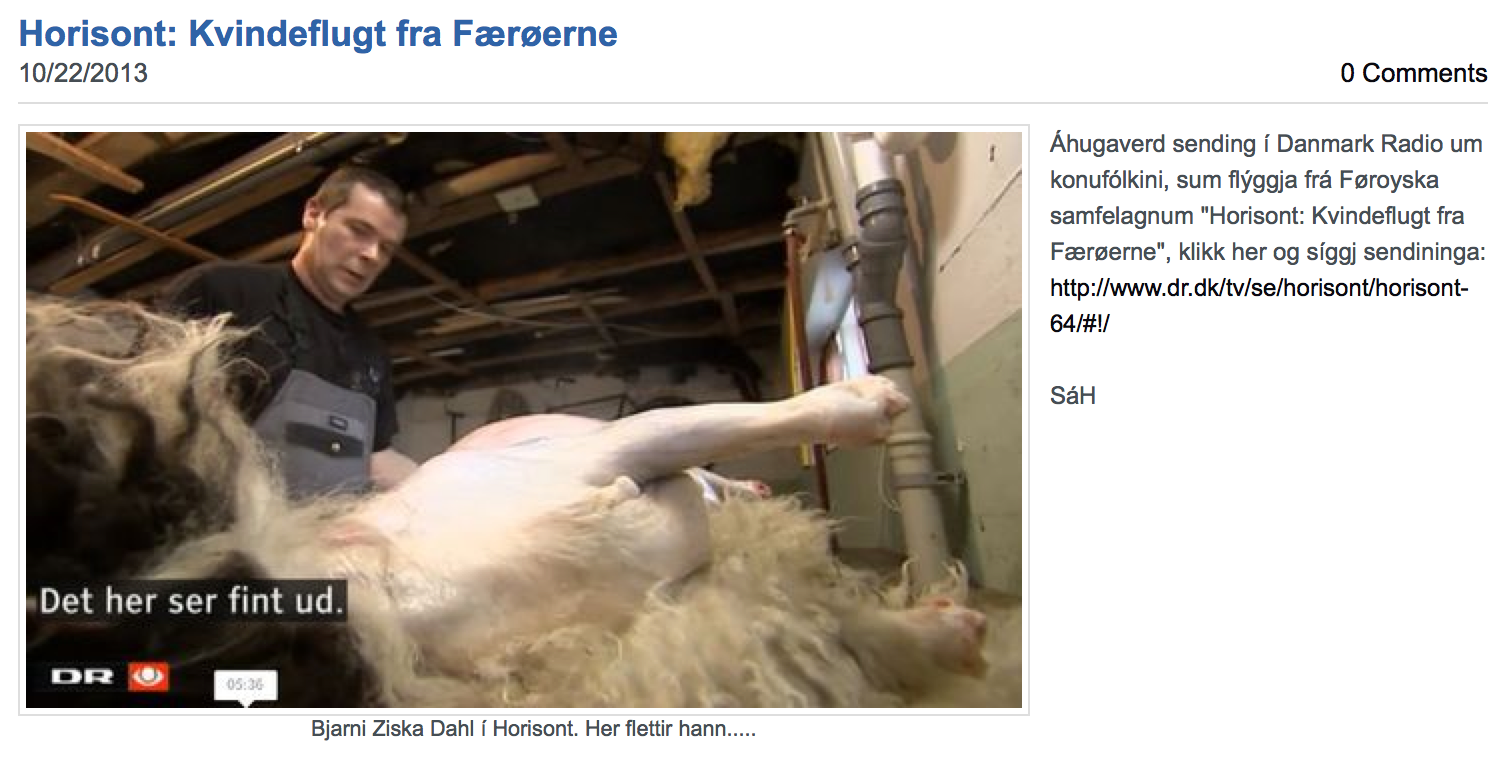
A quick look at current Fareose demographics reveals an oddity — the country is short on women. Though the gender imbalance has fallen from a 2012 high (when there were over 2,000 more men than women in the country), there’s still a striking and problematic discrepancy, especially when you consider that the missing women are mostly in their twenties and thirties, prime ages for dating and having children.
Media coverage and common sense would have you believe that the Faroe Islands is facing an enormous problem in the near future, as fewer women means fewer babies. Population growth could stagnate or reverse if no incentives are made for the women to come home, or if new women aren’t found elsewhere, such as from Thailand or the Philippines. In other places, gender imbalances are also known for leading to all sorts of sociological ills, such as increased violence against women.
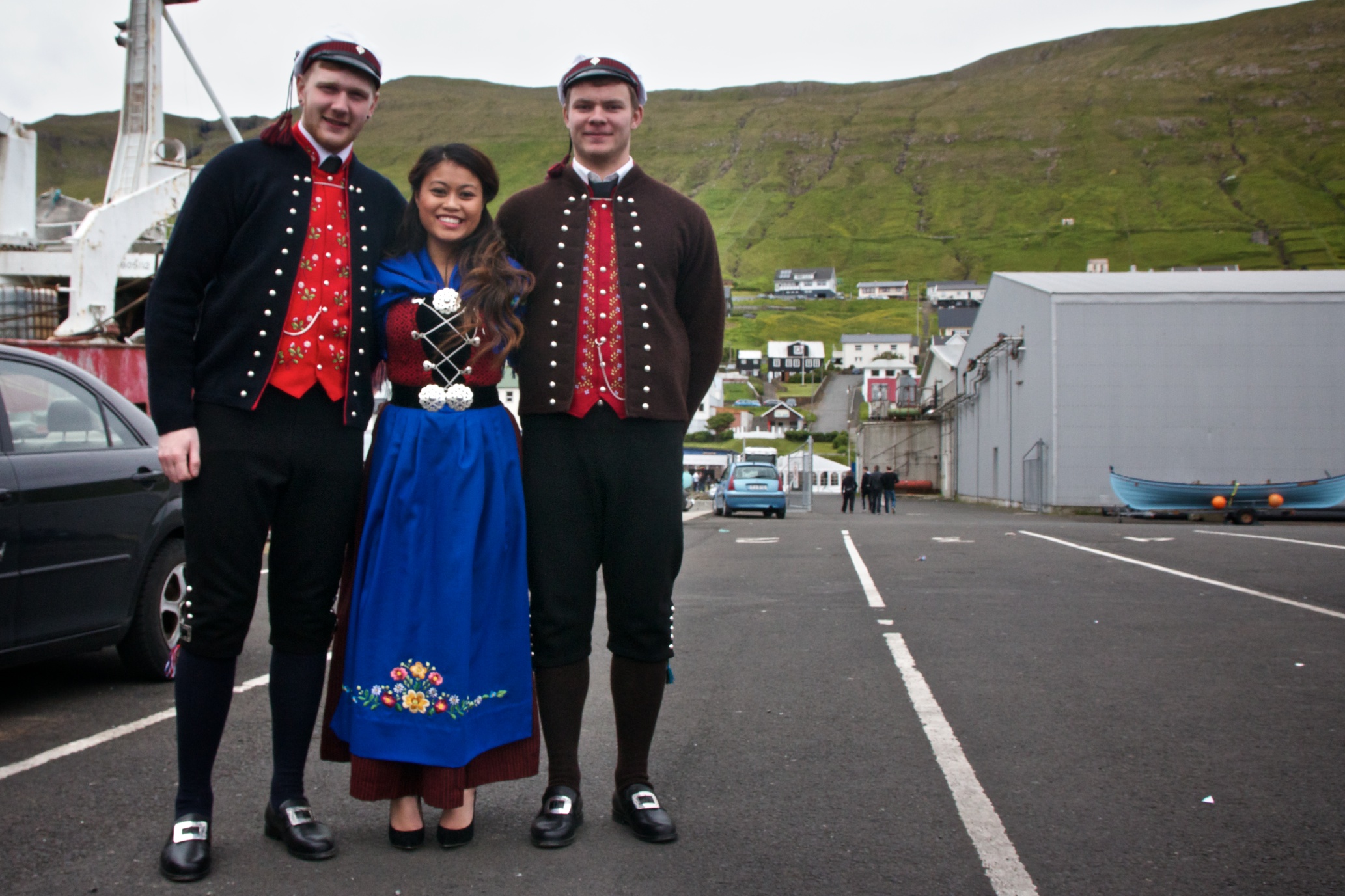
A young Thai-Faroese woman attends the Joansøka festival in Vágur, Suðuroy, with her boyfriend and another friend.
But since coming to the Faroes a month ago, I’ve seen none of that. Okay, so I’ve seen a few ethnically Asian women here and there. Mostly beautiful, with very cute children. And maybe they’re the reason that I can buy coconut milk and curry paste in even the smallest Faroese grocery store. If that’s the case, I’m grateful to them. I have a hard time living on meat and potatoes alone, even smothered in tasty Faroese gravy.
Otherwise, though, the country seems to be missing its ‘missing’ women. Everyone knows where they women have gone — Denmark, mostly — but where are the holes they’ve left behind?
I’m just not seeing many schools shuttering for lack of children, restless single men, women left behind by all their friends and desperate to get away. Yes, everyone knows someone who has “gone down” to Denmark to study or work, and most families have at least one member away across the water, but it’s young men they’re missing, too. And most are hoping to come home to the Faroes in due time.
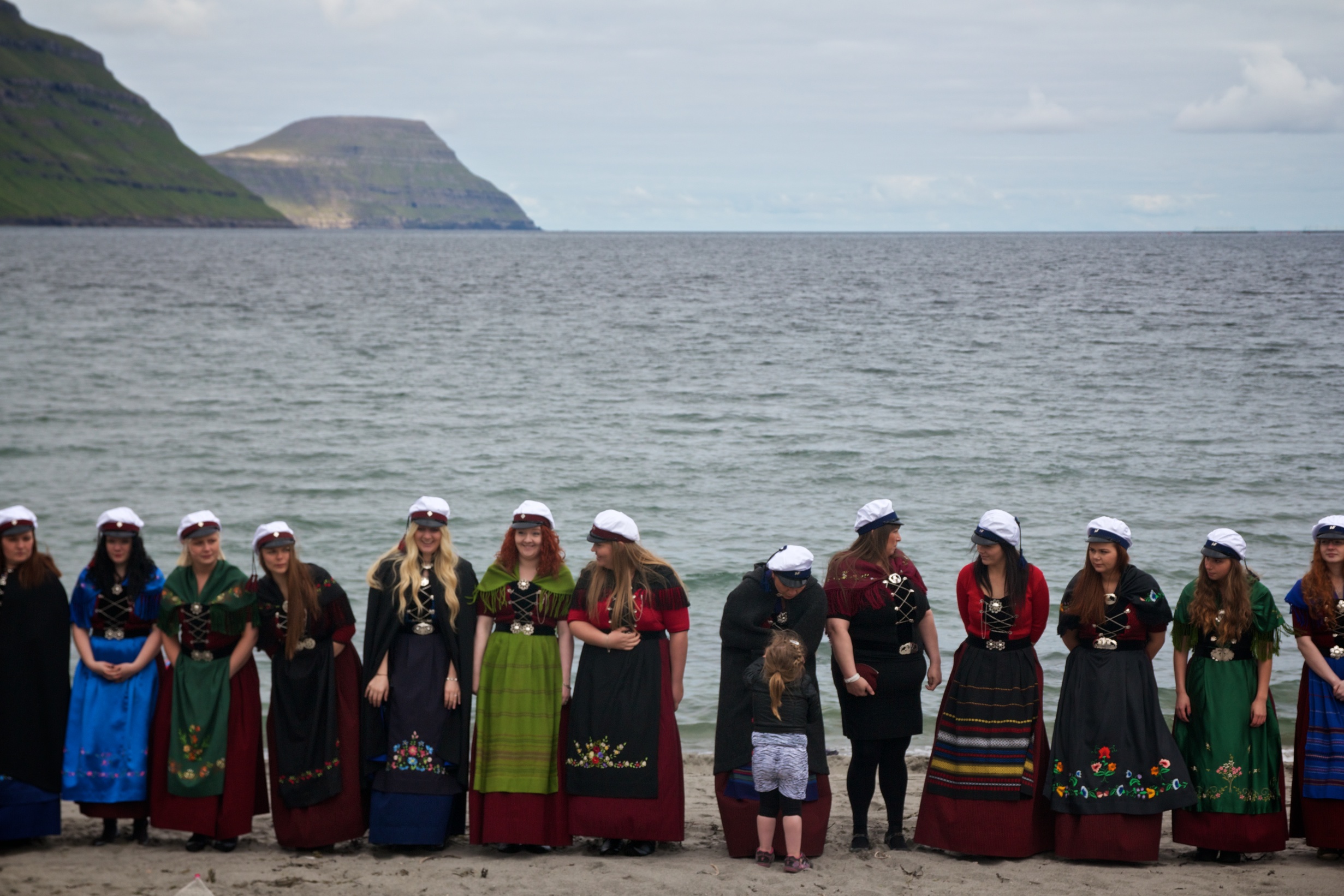
Graduates of the Studentaskúlin (junior college) in Eysturoy gather on the beach in Gøtu as part of their graduation ceremony. This year’s graduating class was more than two-thirds female.
Most people I’ve asked about the lack of women know that the issue exists, but in an almost abstract sense. They all know women who have gone abroad, and they understand why — to get certain types of educations, pursue certain careers, to marry foreign men with whom they’ve fallen in love — but they’re not seeing dramatic effects, and they don’t seem too worried about the future. They don’t believe they’re in a society on the verge of collapse, instead they are optimistic that, despite some problems, things are moving in the right direction.
Take this all “with a grain of salt,” because I still need to do some actual background reporting on this issue, gather statistics and hard facts and talk to the experts. So far, I just have my own observations and those of the many women who have so far made time to talk to me.
“No, no, I don’t see it,” says Bára Joensen, a mother of three who lives in Norðragøta. “The only thing is that some are getting foreign women. But I haven’t really noticed that there are more men.”
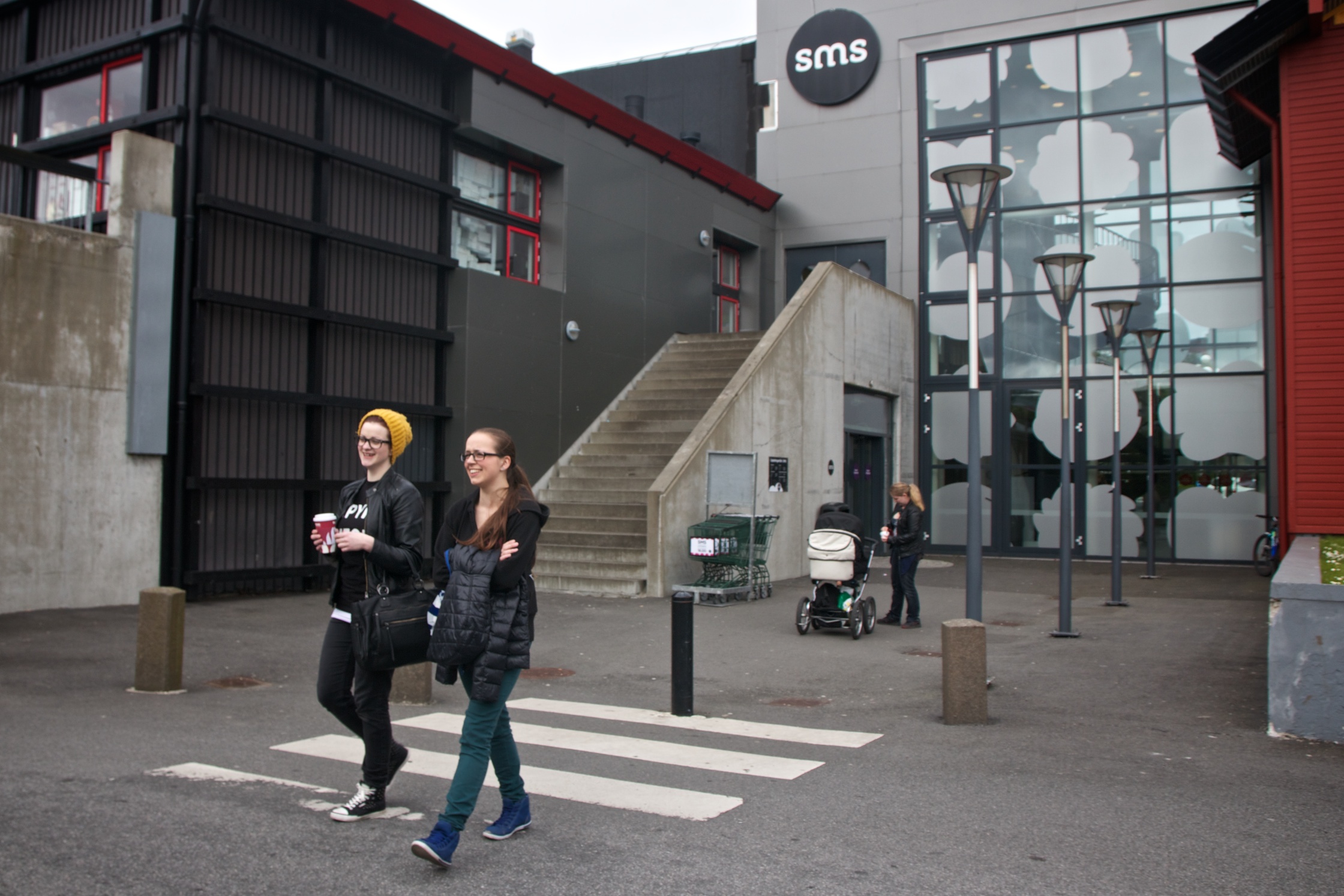
Jóna Venned walks with a friend outside of the SMS shopping center in Tórshavn. Jóna has been abroad to work in Switzerland and travel and visit friends in several other countries. She will leave next year to study in Denmark, but plans to move back home to the Faroe Islands afterward.
“I think the circumstances have changed and it is a lot easier to be a woman in the Faroe Islands compared to what it has been. It is kind of conservative, it has always been conservative,” says Jóna Venned, a 24-year-old from Tórshavn. She says the society is continuing to move towards greater equality in homes and workplaces, and that there is also an effort underway to make it easier for single parents to live in the Faroes.
The weather was gorgeous on a recent trip to Tórshavn, and between the blue skies and the huge cruise ship docked in the harbor, the city was full of lively activity… and one man taking a nap in the sunshine!
I’m about halfway through my Faroese summer, and nowhere near ready to leave. Right now, I’m wandering around in a bit of a midsummer haze. My days and nights are flipped almost completely upside down. I can’t remember the last time I went to bed before 4 am or got up before noon… I think it’s been a week. Mostly to break the cycle, I’ve planned a trip to Tórshavn and Nólsoy tomorrow, so I have to get up in time to take the 8 am bus.
I think it’s time to say I’ve learned what I’ve needed to learn and met the people I’ve needed to meet in order to really do the bulk of my work here. Of course I could still keep learning and practicing and preparing forever, but the halfway point is a good time to wake up and realize that I need to really get started on serious formal interviews, writing, and such.
In three weeks, things are going to start getting really crazy here. My last few weeks in the Faroe Islands are going to see the G! Festival in my home village, the Ólavsøka national day and festival in Tórshavn, and my best friend here taking off work for a few weeks so that we can travel around and see as much of the country as possible. So I’m going to try to get some of the work done now, before the summer really lights on fire…
Here’s what my halfway point looks like, by the numbers:
Days spent in the Faroes: 34
Days left in the Faroes: 39
Photos taken: 8,814
Faroese words I know: 2,000+ (ability to speak badly, unlocked!)
Manual gears acquainted with: 5 (ability to drive badly, unlocked!)
Faroe Islands Unvisited: 9
Nólsoy, Hestur, Sandoy, Svínoy, Fugloy, Mykines (still plan to visit)
Skúvoy, Stóra og Lítla Dímun (maybe not this year)
Blog posts published: 12
Blog drafts sitting in the edit queue: 8 (!)
Formal interviews conducted and recorded: 4 Formal interviews planned for the coming week:4
Cups of tea consumed: 69+
Containers of garlic cheese consumed: 7
Bags of “chokoflager” cookies consumed: 4
Potatoes peeled in the correct Faroese style: < 2
Potatoes peeled in Miranda’s crass, uncultured way: > 15
Potatoes eaten unpeeled: > 15
Hours spent watching Dagur og Vika, reading Portal.fo and listening to Útvarp Føroya: 20+
Words in the “Comprehensive Faroese Vocabulary” Memrise course I’m helping create: 1,107
Faroese (and fellow Faroe-phile) Facebook friends: 58 Times mistaken for a Sea Shepherd Spy: 3+
New Definition of “Good Weather”: 10°C/50°F (and not rainy or foggy)
New Definition of “Hot Summer Weather”: 15.5°C/60°F (and maybe some sun)
New Definition of “Grass Green”: #00FF00
New Definition of “Large”: 500-inhabitant villages
New Definition of “Busy”: 8 cars in a parking lot…
Faroese social media is exploding with commentary about Sea Shepherd’s Grindstop 2014 anti-whaling campaign.
The Faroe Islands is being invaded this summer by The Sea Shepherd Conversation Society, which is coming with more than 500 volunteers in an attempt to stop the Grindadráp, or Faroese whale hunt, by “monitoring the 23 grind bays, deterring the dolphins from shore, and taking direct action to intervene against a grind if necessary.” Operation Grindstop 2014 will be the largest land- and sea-based campaign in the organization’s history.
The Grindadráp and Sea Shepherd are both controversial in their own way.
The Grindadráp / Faroese Killing of Pilot Whales
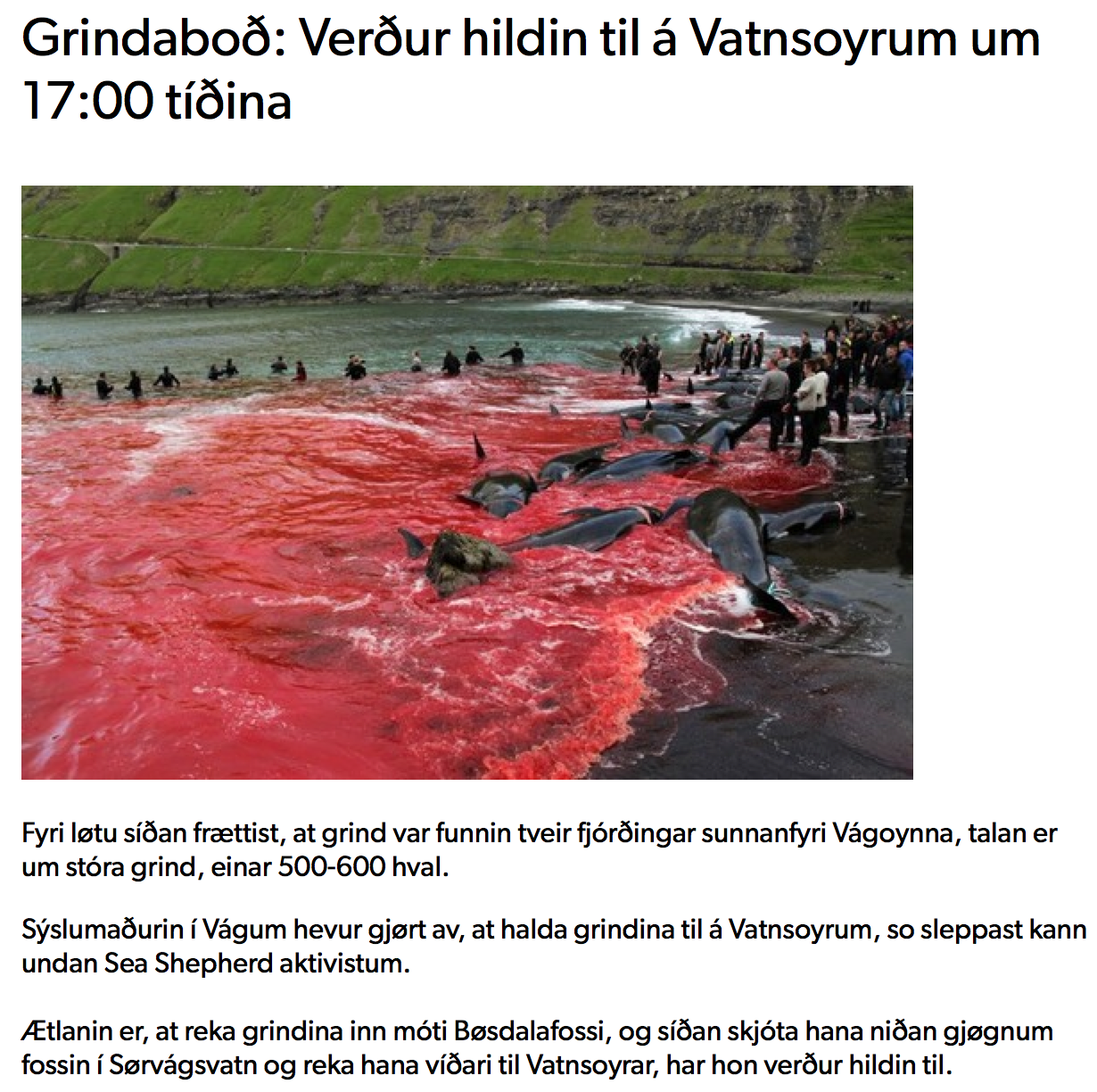
Photo: FaroeIslandsPhoto.com / Kasper Solberg
The Faroese have hunted pilot whales for hundreds of years, and their meat and blubber formed an invaluable part of their diet in the past, when food was scarce in this remote part of the world. Even today, whale meat and blubber is the Faroese national dish, and the hunt is considered one of the cornerstones of Faroese culture. The main threat to the consumption of pilot whale, as the Faroese see it, are the health effects of the high mercury content in whale meat today.
The pilot whale is not listed as an endangered species (as some anti-whaling activists claim) and the hunt is not considered to be a threat by organizations such as the International Union for Conservation of Nature, the American Cetacean Society, and the North Atlantic Marine Mammal Commission to pose a threat to the species. The IUCN’s Red List listing of the pilot whale says that “the Faroese catch is probably sustainable.”
While some argue that the tradition is outdated and unnecessarily cruel, especially since it involves the killing of such intelligent or otherwise special animals, many Faroese argue that killing whales for food in the grindadráp is as humane, if not more so, than the slaughter of factory-raised animals, which merely has the public relations advantage of taking place behind closed doors so the blood doesn’t disturb the grocery-shopping, meat-eating public.
Sea Shepherd is an environmental activist group whose founder, Paul Watson, split off from Greenpeace due to his confrontational tactics. Many people around the world see Sea Shepherd’s members and volunteers as heroes protecting the whales, and they have a large media presence including, in the past, a reality TV show called Whale Wars. Others, however, decry the organization’s disregard for facts and their vigilante actions (they have been called eco-terrorists and faced charges for assault and sabotage, among others).
For more on the Sea Shepherd controversy, you can find many news articles about Paul Watson and the organization, such as this one from The Telegraph.
Grindstop 2014: The Beginning
The Sea Shepherd Grindstop volunteers started arriving in the Faroes last week, provoking a wide range of reactions from Faroe Islanders. Many wish the protestors would not be allowed into the country. Others say that it is important to treat them with respect as visitors, and that, on the bright side, they will be forced to spend money in the islands. There is also a small group of Faroe Islanders who are themselves against the grindadráp, despite the inherent difficulty of going against the established culture in a small community. A Facebook group called “Faroe Islanders against the Grind” counts 104 members.
Faroe Islanders Against the Grind
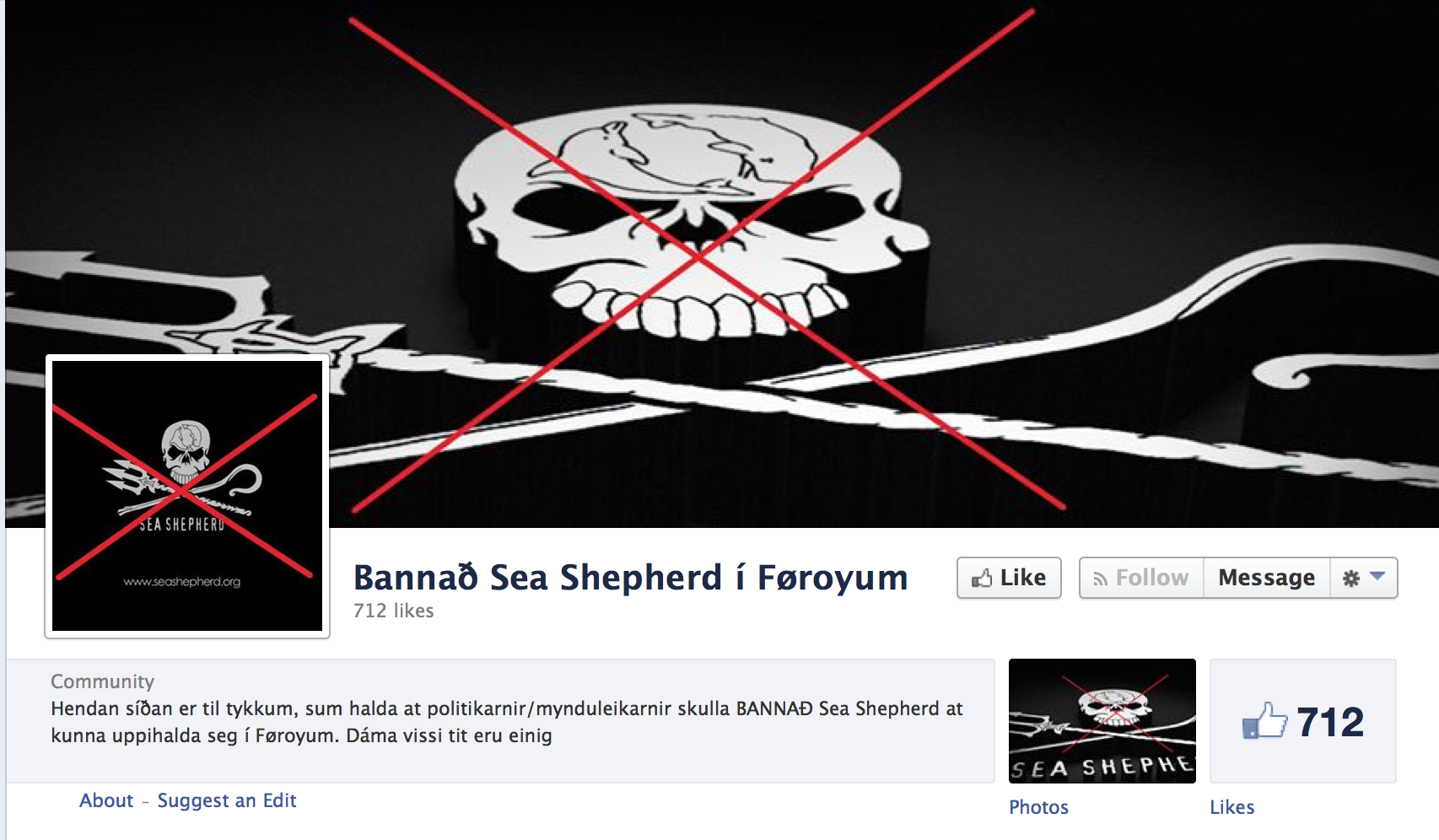
In comparison, another Facebook group was created about three hours ago to call for banning Sea Shepherd from the Faroe Islands. The group currently has 712 members.
Ban Sea Shepherd
Whatever the attitude, the presence of such a large group is bound to have an impact on the islands this summer. With fewer than 50,000 people living in the Faroe Islands, 500 protestors can be considered the equivalent of 3 million foreign Muslims, Jews and vegetarians invading the United States to demand that Americans stop slaughtering pigs and consuming pork products.
One satirical Faroese website even went to far as to announce a fake grindadráp, which it said would be held at Vatnsoyrar — the only village that is not on the coastline, but rather on the shores of the largest Faroese lake! The explanation was that in order to avoid Sea Shepherd, they would shoot the whales through a waterfall. I don’t know whether any Sea Shepherd people showed up in Vatnsoyrar, but I did find the link posted to their Grindstop Facebook page by concerned readers.
Fake Grindadráp in Vatnsoyrar
Faroese people have also taken to defending themselves and asking questions back at the activists through social media. Oddur Á Lakjuni wrote, “I’m wondering here: The Faroese kill more sheep than they do whales… But there’s not a word of criticism from anywhere. Both are killed for food – although neither is absolutely necessary for survival (and to be honest: which item of food is, when you take it in isolation?)”
The volunteers have been scouting out beaches and appear to be rather bored, if social media updates consisting almost exclusively of volunteers looking out onto the empty sea and videos such as this one are anything to go by:
Mimmy Vágsheyg, a Faroese woman who opened a new cafe in Klaksvík this year, says that anti-whaling advocates have been harassing her online for months, sending her messages filled with graphic images and leaving phony bad reviews on her business listings. Vágsheyg does not serve whale meat at her cafe, but thinks that the group must be indiscriminately targeting Faroese businesses. “I’m just getting started here, I don’t need this!” she said.
Since Sea Shepherd started arriving en masse last week, Vágsheyg says they have come into her cafe to repeatedly check her menus for incriminating items. “I don’t understand why they come every day. Do they think I am hiding the whale?”
Now that I have been in the Faroe Islands for a few weeks, I have gotten started with my research interviews. I plan to talk to several Faroe Islanders of varying ages, genders, and places of residence about how the Faroe Islands are represented to foreigners through various media channels, and how they feel about those representations.
So far, I have conducted three formal interviews and more than a dozen informal conversations on this topic. One trend that has started to suggest itself is that the older interviewees have been more positive about representations of the Faroe Islands than the younger interviewees, even suggesting that the tourism imagery shows the islands in an unrealistically good light, while the younger interviewees seemed more bitter about anti-whaling sentiment and outdated representations.
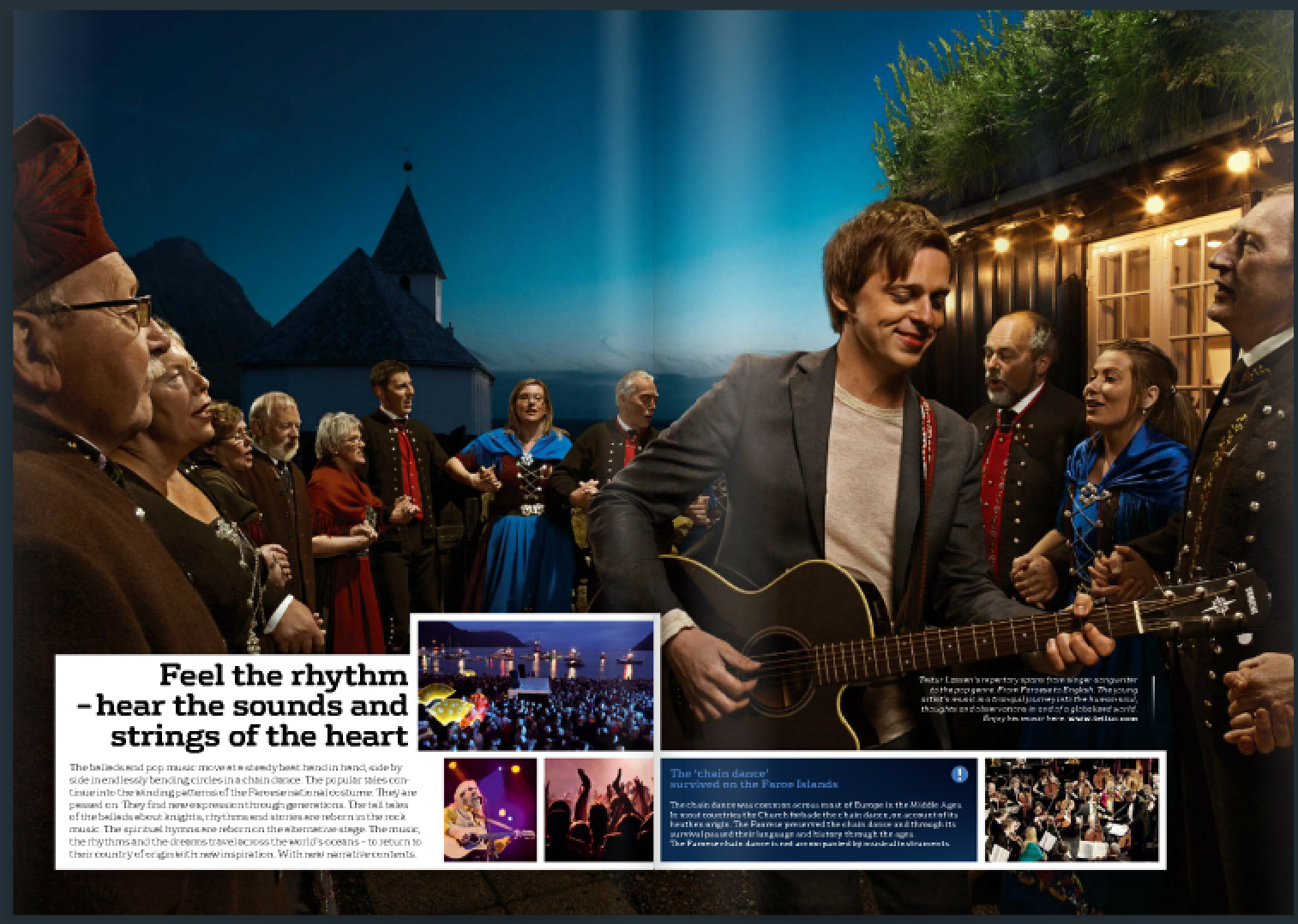
A two-page spread from Visit Faroe Islands’ new tourism booklets. This is one of the images I ask respondents to consider in the final part of the interview.
One amusing wrinkle in the interviews has been that many respondents have recognized people they know in the example media I’m presenting to them. In my very first interview, I showed part of a video, and my interviewee asked me if I would like him to introduce me to the people speaking in the video. In another interview, when I showed the above photo of the Faroese ring dance, the interviewee told me that she recognized “almost everyone” in the photograph, as they were all from Klaksvík!
When I was planning the interviews, the possible frames I felt that I had seen in representations of the Faroe Islands were exotification (through emphasis on the traditional ways of life or the remote, wild natural conditions), trivialization (due to the nation’s small size), and conflict (presenting the Faroe Islands as backwards, especially in regards to the controversial grindadráp).
So far, no one has mentioned the trivialization frame, except to say that many people are not aware of the Faroe Islands at all. One man told me an anecdote in which he was travelling and tried to explain where he was from to some people who had never heard of the Faroes. He said that it was in between Scotland and Iceland, and they insisted that no such country existed. He looked around for a map of Europe, and when he found one, the map itself was missing the Faroe Islands! He had to find a second map to prove that he was, indeed, from a real place.
Here are the main points I’ve heard so far about depictions of the Faroe Islands:
A screenshot and description of the Danish tv documentary, “Kvindeflugt fra Færoerne,” which is about the gender disparity in the Faroe Islands. This is one of the images I ask respondents to consider in the final part of the interview.
– They focus more on old traditions, such as the ring dance, and less on growing, current trends like modern music and cuisine.
– They are antiquated, and haven’t caught up with the changes of the last 10-30 years.
– They imply that everyone in the Faroes is a sheep farmer or a fisherman.
– They play down or ignore the existence of modern institutions like hospitals, shops, and the University.
– Information about the Grindadráp is filled with inaccurate claims, such as that the pilot whales are endangered or killed for fun.
– They have beautiful photosand descriptions of the unique Faroese nature.
– However, they could be painting an unrealistic picture of good weather and endlessly clear skies, conditions which are rare in the Faroes though they do occur.
– They ignore the winter almost completely in favor of coverage of the brief tourism season (June-August).
– They are concerned that tourists might not understand that the Faroese weather is uncertain and changeable, and that everything in the Faroes is expensive.
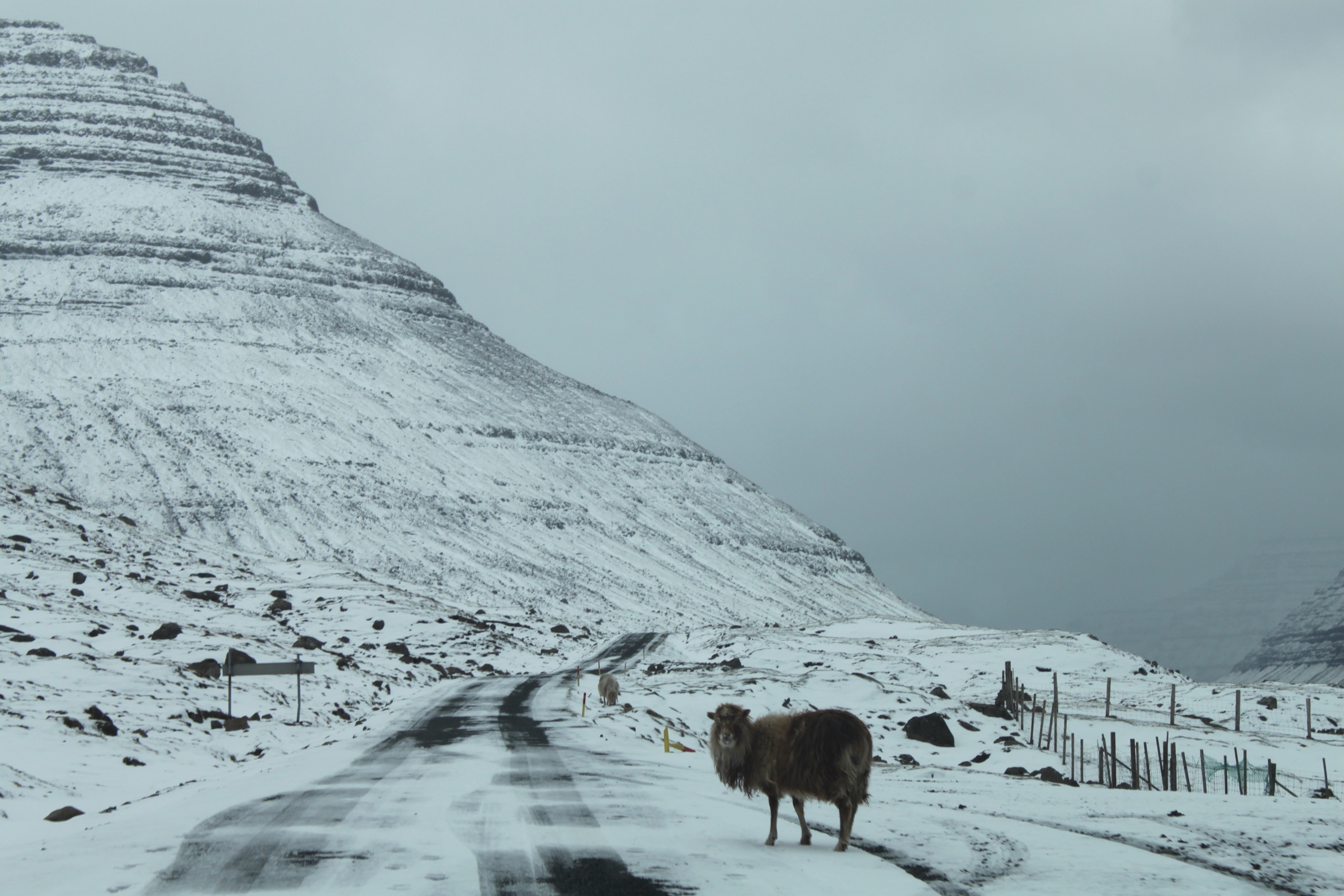
A sheep walking on the road leading to the village of Múli. This is one of the images I ask respondents to consider in the final part of the interview.
So far, one of the most intriguing things to come up in an interview was one woman’s suggestion that many of the problems she saw in representations of the Faroe Islands had the same problematic root — that foreigners almost never travel to the islands in the winter. Not only does that ignore more than half of the year in the Faroes, she thinks the long, dark, stormy winter has a huge effect on the Faroese culture, and that, without understanding that, it’s impossible to explain the Faroese mentality or perspective on a wide range of issues.















 Adventures in the Land of Maybe