Category Archives: My Faroese Adventures

10 Years Later…

It’s been eighteen years since I first heard of the Faroe Islands. Sixteen years since I found a Faroese friend online and started trying to learn the language. Twelve years since that first magical, snowy visit.

And it’s been ten years — a full decade, somehow! — since I spent a whole summer on the islands, learning Faroese and working on my graduate project for the Missouri School of Journalism. 

My life has changed significantly in the intervening years. I’m now a World Language teacher, and live with my husband in Washington, D.C. 

And I still feel a powerful connection to the Faroe Islands.

I’ve returned several times, seven magical summers: each a happy return, each somehow a little different. I’ve made unforgettable memories at ‘home’ in Gøta and Tórshavn, and gone on marvellous adventures to some of the most remote corners of the islands. One year, my penpal came along from Finland; another year, a dear old friend from grade school. Most recently, my husband finally saw the place I’ve been telling him about for years!

My husband, Nash, and I on a 2022 visit to the Faroe Islands.

The Faroes too have changed, as everything on Earth must. 

It’s 2024, and in many ways, the future has come to the Faroes. Atlantic Airways runs direct flights between New York and the Faroe Islands. The new Hilton Garden Inn in Tórshavn has more than 100 fancy guest rooms.

Eysturoyartunnilin opened in 2020 as the world’s second-longest sub-sea road tunnel, cutting the drive between Tórshavn and Runavík, once a winding hour-plus of following the fjords, to a snappy 20 minute short-cut under the sea. The tunnel even features the world’s first sub-sea roundabout, allowing drivers to exit in Strendur on the other side of Skálafjørður.

As of 2023, Sandoyartunnilin has brought the island of Sandoy into the “Faroese Mainland” that can be driven without a ferry crossing. If all goes well, Sandoy will be a stepping stone for the Suðuroyartunnil that will add Suðuroy, the southernmost and last large unconnected island, to the main Faroese road network. Some proposals even include a quick stop in Skúvoy (population 40) which is among the smallest and most remote islands in the archipelago.

In more personal news, my host family has grown, by three fantastic children, and recently come to visit me in the United States!

My ‘home village’ of Gøta has a new playground, beloved by my Faroese niece-of-sorts. The town-hall, stone picnic table, and riverside path were also pleasant additions to the village landscape. The town-hall has won architectural awards for blending Faroese tradition with modern Nordic design… but it’s also broken the sight-lines down the river to the fjord. And the new footbridge crosses the stream just where I used to leap from stone to stone, where I took a low-vantage-point photo I submitted as part of my graduate portfolio. I can’t take that photo again, nor cross over those stones… but that’s just how life goes. No doubt there were people in the Faroes who mourned the unspoiled mountains when they put in the roads that are now an essential part of life.

More foreigners than ever are now visiting the Faroes. It’s impossible not to have a whirlwind of emotions about that, especially when I’m quite complicit — I’ve encouraged roughly everyone I’ve met in the last decade to travel there. The tourism boom is good for the economy, and for certain facets of the culture. Other traditions are threatened. Debates about access to the Faroese nature, almost all of which is privately held, have pitted neighbors against each other, where once the feeling was that one could walk in the hagi (outfield) without asking any special permission. 

But the Faroe Islands are still Faroese, and I remain utterly enchanted by this strange and wonderful little nation.

As I write this, a strike by multiple labor unions has all of the islands in its grip. The fresh food ran out almost immediately, followed by the gas and diesel, and now even the potatoes, pasta, and frozen food is running low. There’s still dairy though, and fish, and fresh pilot whale from a recent grindadráp in Hvannasund. 

Plus ça change, plus c’est la même chose —

Jú meira tað broytist, jú meira verður tað tað sama.

Parrot Time – Faroese Edition

Norðragøta on the cover of Parrot Time's special Faroe Islands issue.

Norðragøta on the cover of Parrot Time’s special Faroe Islands issue.

This month, my love for the Faroe Islands had an exciting new platform — a special issue of a magazine!

Parrot Time is a linguistic and cultural emagazine published bimonthly by the Parleremo language learning community. The magazine’s editor-in-chief, Erik Zidowecki, contacted me based on our conversations about the Faroe Islands to ask whether I would be interested in helping him put together a special issue focusing on Faroese topics. Naturally, I was very excited to work on the project. With the help of four Faroe Islanders, we published eleven articles on subjects ranging from summer festivals on the islands and the new feature film Ludo to the presence of Danish in Faroese life and the Faroese perspective on the whaling controversy. I’m very happy with the way the magazine came together with such a wide variety of pieces and beautiful photographs.

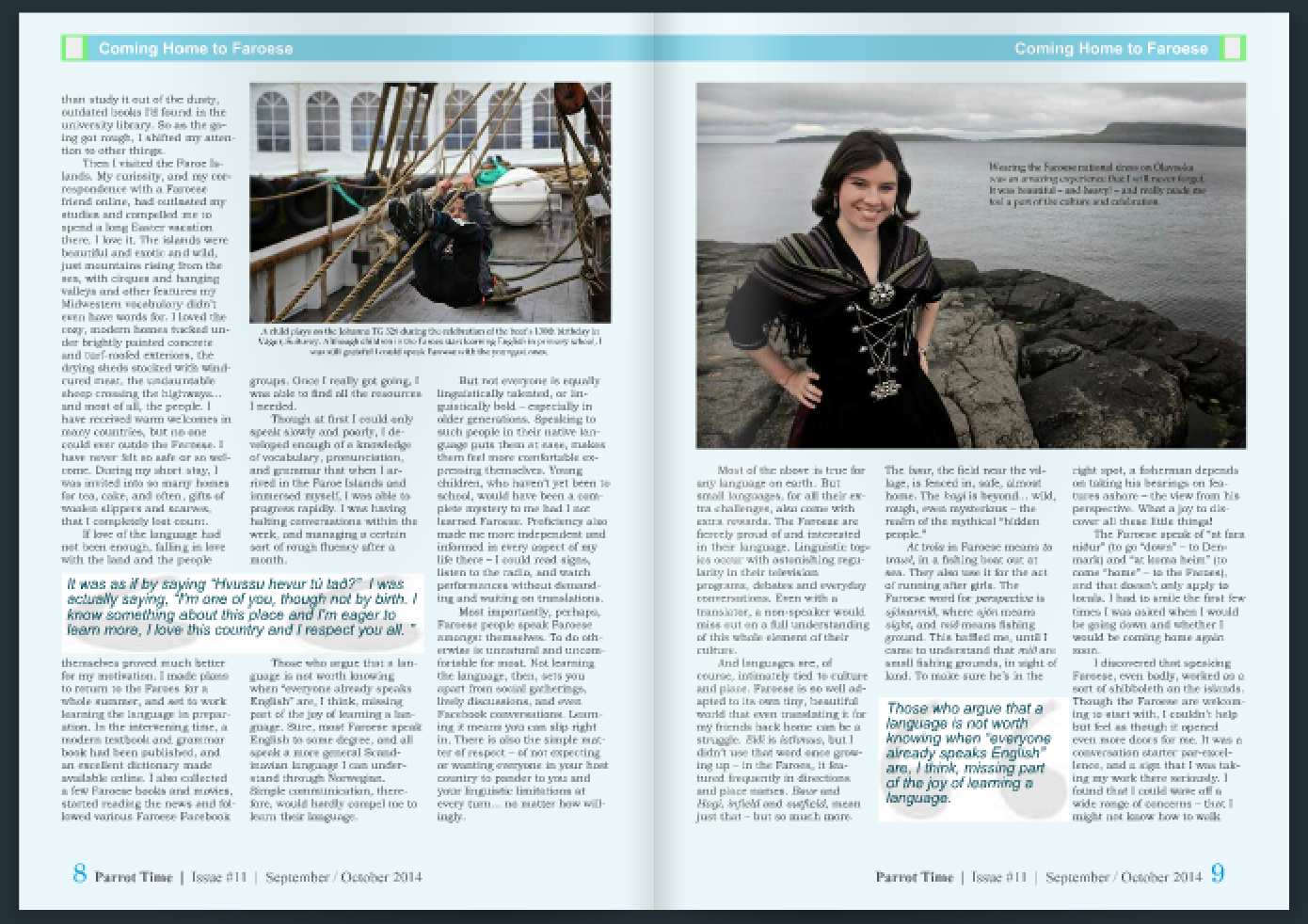
From my article "Coming Home to Faroese" in Parrot Time's special Faroe Islands issue.

From my article “Coming Home to Faroese” in Parrot Time’s special Faroe Islands issue.

Coming Home to Faroese” was my main feature story for the magazine. By exploring the richness that learning Faroese has brought to my life, I wrote about the challenges and rewards of learning a language with a small number of speakers. Here’s an excerpt:

“I remember how it felt to speak Faroese down in Copenhagen, to navigate through the crowded city and yet feel as if I had never left the islands when I heard the language I had learned to love so well. The Danes and other foreigners that passed were none the wiser that something didn’t add up, that I was an imposter, that I didn’t belong. In a way I did. In that moment, I felt I could just glimpse, just taste, that feeling of being a part of something… smaller. Something more intimate. Of what it meant to know just from a language that you were home.”

The readable PDF version of the magazine can be viewed for free at the following address: http://issuu.com/abavagada/docs/parrottime_issue_011/3?e=6771516/9612833

From Island to Island

Not content with visiting 16 islands and an islet in the Faroes, I planned a long way home, postponing my return to the mainland by two weeks and stops on the islands of Amager and Zealand (Denmark), Great Britain (England and Wales), The Isle of Man, and Ireland. Just as I had done on my way in through Norway, I kept my eyes and ears open for traces of the Faroe Islands in its neighboring countries.

First Stop: Denmark

Copenhagen Faroe Islands

The Faroe Islands are part of the Kingdom of Denmark, and Faroe Islanders often joke that Copenhagen is the largest Faroese city, since the population of ethnic Faroese there is higher than that of Tórshavn. Logically, then, I expected it to be easy to find the Faroese here. And it was… and wasn’t.

First, I tried to find some Faroese people. This task was much harder than I’d anticipated, because so many of the Faroese residents of Copenhagen were on summer holiday at the time — in fact, most of them were visiting their family back home on the islands!

Still, I found myself joined by a whole Atlantic Airways flight of islanders going the other way — and I even knew many of them personally. And so I had the surreal experience of traveling, for however short a time, with Faroese people and speaking with them in Faroese while the Danes carried on around us, not understanding more than a word here or there. It was an oddly cozy feeling.

Through the wonders of the internet and multi-degree connectivity, I’d also managed to track down two Faroese women currently residing in the city – Heidi and Krista. Heidi invited me to temunn and breakfast at her home, and gave me insight into how she has carried her Faroese identity while living and, to a large degree, assimilating into Danish society. Krista and I spent two fun evenings together while we chatted about her own life and plans. Krista has been in Copenhagen for a far shorter time than Heidi, spends most of her time with the Faroese people living there, and plans to return to the Faroe Islands as soon after getting more work experience in Denmark.

It was also fashion week, and among the other big names being interviewed live and broadcast on a big screen in the city center, I saw a name and a face that was by this time familiar: Barbara í Gongini, a famous Faroese designer.

Aside from the Faroese themselves, there was little in Copenhagen to remind me of the Faroe Islands. The land was flat, the buildings tall, the streets busy, the sky startlingly big and blue after spending time in the misty Faroese mountains. Oh, and it was hot! I broke out pieces of my wardrobe that hadn’t seen the light of day since I’d packed them optimistically into my suitcase in May.

Faroese House Copenhagen

The Faroese House in Copenhagen

I made a map of Faroese places and things I might be able to see in the city. There was The Faroese House, a cultural meeting place and cafe; it was closed for the summer holidays. The “Faroese student ghetto” of Øresundskollegiet was likewise empty for the season. I found nothing Faroese in the Danish National Museum, which returned most such artifacts to the National Museum of the Faroe Islands several years ago. A search for Faroese restaurants, or even a restaurant serving Faroese ingredients, revealed only that Tórshavn’s beloved sushi restaurant, Etika, had tried in 2010 to establish a Copenhagen branch; despite some good initial reviews, it had not even lasted a season.

I took a walking tour of Copenhagen, which started outside the City Hall. Our guide proudly told us that the polar bears on the hall’s roof were there to represent Greenland, a Danish territory. As we started walking, I asked her to please point out to me if we passed anything related to the Faroe Islands.

She answered shortly: “No. There’s nothing about the Faroe Islands.”

“Okay,” I began, “Thanks anyw — ”

“In fact,” she continued, “I don’t really know anything about the Faroe Islands. At all.”

Most of the Danes I met were not so abrupt. Still, if my summer plans came up, most didn’t comment at all. Some said it was interesting in a tone that told me they thought it was anything but. There were exceptions. I met another journalist who had been living in Greenland, and we were eager to hear about each other’s work. And one young woman excitedly asked me if I was Faroese — she had spent time in the Faroe Islands, and recognized my sweater.

On the whole, the Danes just didn’t show anywhere near the interest that the Norwegians had back in Bergen, which I found a little bit strange considering the relationship between the two nations.

Second Stop: Great Britain

Cotswolds Islands

I was one degree and ten minutes away from a Faroese man in Oxford. They get around, I’m finding. I met a Cuban man in my hostel, and when he heard why I was in Europe, he threw up his hands in astonishment. “Seriously?” he asked, “I just found out about that place ten minutes ago! I was talking to this awesome Faroese guy at my conference. This is too weird.”

The British occupied the Faroe Islands during World War II and left behind an airport, a strong tea-drinking tradition and Cadbury chocolate. But the cultural exchange was mostly unilateral, and the rest of my connections to the Faroe Islands on Great Britain were comparative. The apologies the locals made for the changeable weather made me smile that one-upping smile. The sea felt so warm. The houses and gardens looked so fine and pretty, even in the small villages of the Cotswalds and the mountains of Wales. The land just seemed so safe, protected, and fertile compared to what I had come from.

A language geek as ever, Welsh fascinated me. I saw more of it than I expected to — just about everything written was bilingual — but I didn’t hear any of it until I reached northern Wales, where I was happy to hear it spoken much more, and by all generations, in Caernarfon. The scarcity still made me a little bit sad. There, I thought, but for the grace of a thousand kilometers of salt water, or some truly commendable island obstinacy, goes Faroese.

Third Stop: The Isle of Man

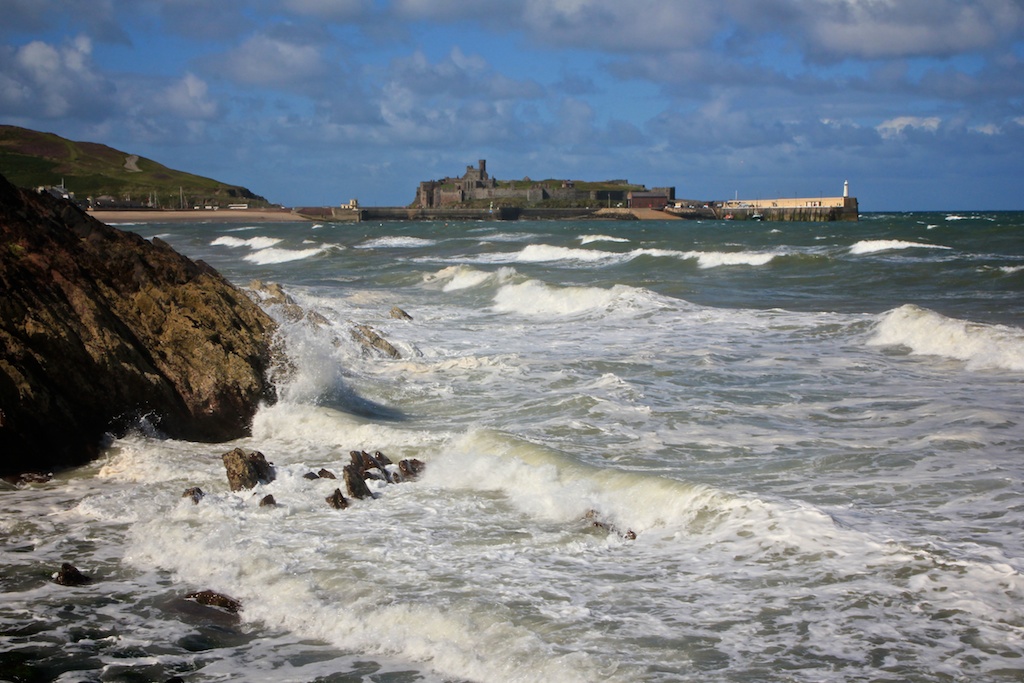
Isle of Man Faroe Islands

I stayed with a family in the Isle of Man who positively astonished me with their knowledge of the Faroes. They asked me intelligent questions about the political system, showed me an old book with photographs of artist Tróndur Patursson harpooning a whale, and expressed avid concern for the puffin colonies on Mykines.

Now, this family was most likely exceptional in this regard: not only especially intellectually curious but specifically about topics that would pull the Faroe Islands into their view. The two island nations are, after all, linked by many obvious political and cultural parallels, varying degrees of Norse heritage, and, especially intriguing to my host’s father (a part-time ornithologist) large populations of sea birds.

The Isle of Man is much bigger than any of the Faroe Islands, and it’s only the one. It was hard for me to buy, comparatively, the word “isolated” describing any of the Manx settlements. The people of Man have a few towns that could reasonably be called cities, albeit small ones, with multiple pubs and Chinese and Indian carry-outs… and lovely, brooding castles. They’ve also got much larger expanses of flat, fertile land as well as trees and forests. Despite some resistance, English has almost completely overtaken their Manx language.

But when I stood on the shore, the strength of the wind took me by surprise and the crashing surf revealed the fury of the full force of the Atlantic, even on a mild and sunny day. And I thought, yes, these islands are close cousins, after all.

Fourth Stop: Ireland

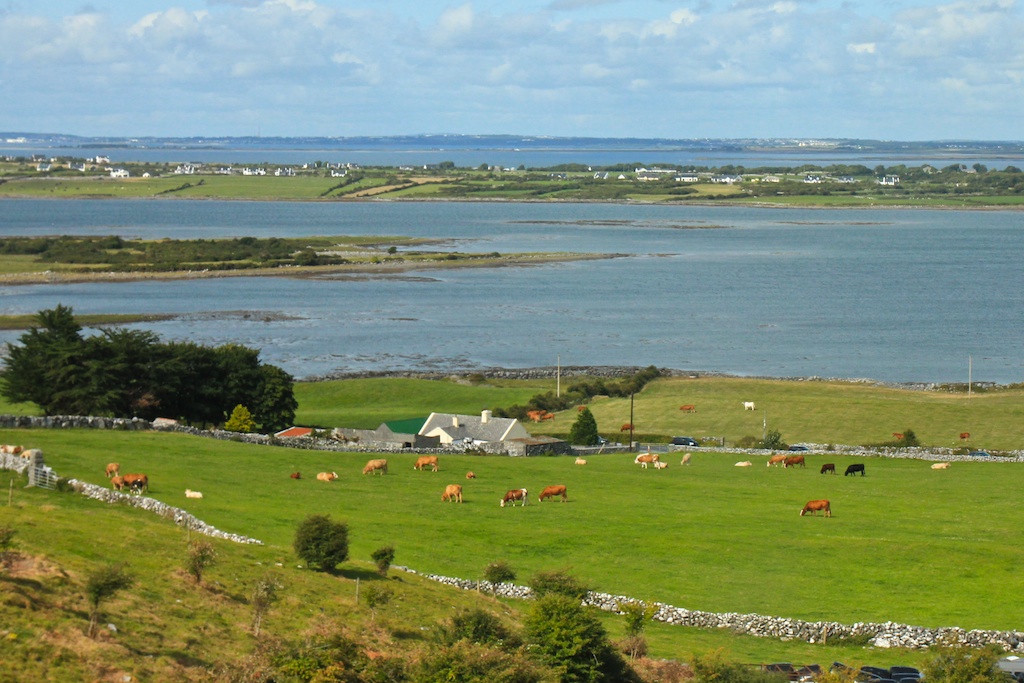
Ireland Faroe Islands

Once I read a long scholarly article that promised to examine the historic cultural relationship between Ireland and the Faroe Islands. It basically concluded there wasn’t any… and wasn’t that strange? Okay. So I didn’t spend much time looking in that direction.

Irish Gaelic, which seems to be doing okay, gave me yet another reminder of how amazing Faroese is doing for such a small language. For my next visit to Ireland, I think I better head to the Aran Islands, which I was able to glimpse not too far off the coast of the Burren. They’re as Gaelic as Gaelic comes, everyone says — that little bit of saltwater separation having a powerful preservative effect.

The Irish landscape was broader and flatter and more forested than the Faroese, once again (it doesn’t take much.) To give credit where it’s due, I experienced more changeable weather in Ireland than anywhere else I’ve ever visited, including the Faroes. So many of these Northern European countries tell the same jokes — “If you don’t like the weather, wait five minutes.” But only in Ireland did I really experience, within the hour, sunshine turn to black skies and driving rain and back again.

The Cliffs of Moher, apparently Ireland’s second most visited tourist attraction, were lovely. But I’d seen just as good in the Faroes and not had to share them with hundreds of Chinese and Midwestern American tourists. And the Irish are going around claiming they have the highest sea cliffs in Europe. You can Google it and see.

“As high as the Cliffs of Moher (217m) are,” our guide said proudly, “they are not the highest in Ireland! For that, you’ll have to go to Sliabh Liag (601m), which are the highest sea cliffs in all of Europe!”

Now, I happen to know that the Faroese Cape Enniberg, which also claims that lofty title (they discount Norway’s Hornelen for not being vertical enough for proper cliffs) rises 750 meters above the sea. When I questioned the guide on the matter while the rest of the bus was going to the bathroom, he sort of deflated.

“Maybe my facts are wrong,” I offered. “I’m not very good at remembering numbers.”

“No, no, you’re probably right,” he said. “This is just what we learned in school…”

I doubt he’ll change his rehearsed speech on the matter. After all, how often is someone going to know enough about some little nowhere islands to call him on it?

180° – Reflections from Half a World Away

My summer in the Faroe Islands is over, but much remains to be done. I left the Faroe Islands a few weeks ago, and after detouring in Denmark, England, Wales, Man, and Ireland on the way home, I’m finally back in Missouri.

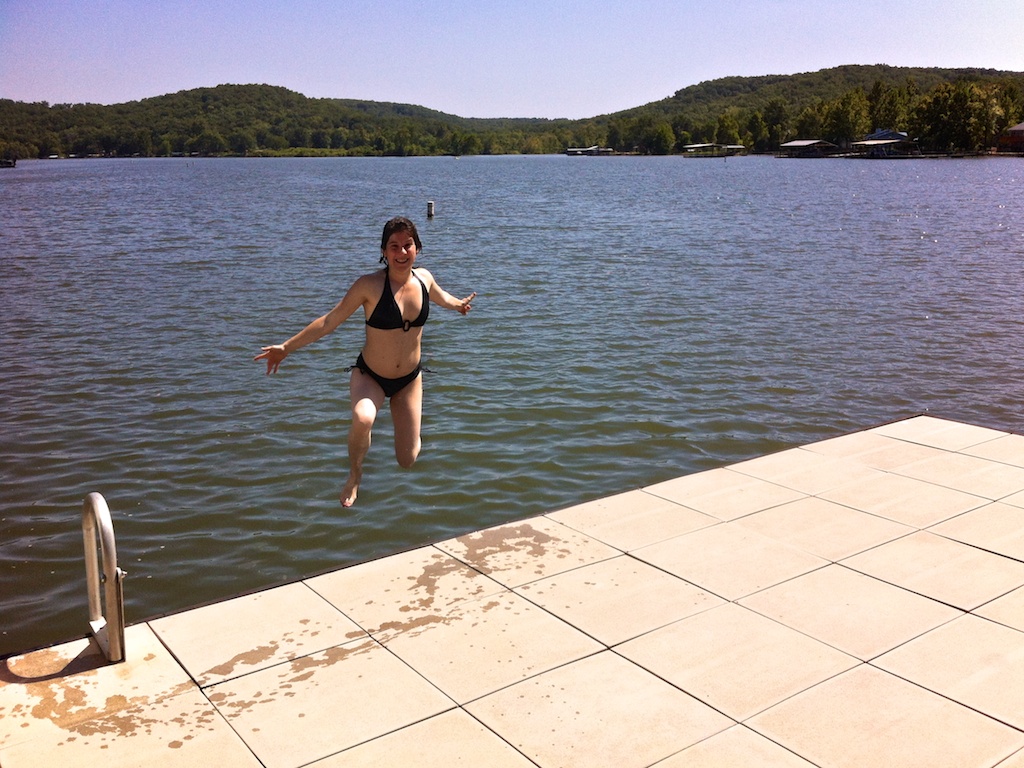
There’s still a lot of summer left here — and here, summer means the concrete’s so hot you can watch your footprints disappear in seconds, sweating is natural and welcome, and the lake water’s so still and warm, you can almost fall asleep in it, lying on your back beneath the stars on a sultry dark night.

Summer in Missouri -- what's always been familiar suddenly feels unfamiliar.

Summer in Missouri — what’s always been familiar suddenly feels unfamiliar.

It’s been a strange transition.

I was able to readjust to some aspects of life off the islands (trees, large buildings, busy roads…) along the way, but it still hit me surprisingly hard to look out of the window of my Chicago – St. Louis flight at endless, hazy blue and realize that it wasn’t the billowing sea I was looking at, but land… an unimaginable amount of solid land.

And then there was the moment I stepped out of the airport — still clad in jeans, wool socks, hiking boots and a long-sleeved shirt (though I had taken my heavy sweater off moments earlier) — and into what felt like a solid wall of heat and humidity. I found myself gasping for breath. The heat index on my first day back reached nearly 42 C.

In quiet moments, I’ve felt a strange longing for the cold blue fog of so many summer nights in Gøta.

And this from the girl who, just a few months ago, had a secret fear of falling off the islands — so unused to the lack of a whole continent as a cradle. The girl who once saw a photo of Greenlandic children wearing thick sweaters in July and swore, shivering, that she’d never live in such a terrible place. The girl whose only reference point, the first time she was enveloped by a rush of bright summer mists, was the cinematic white-out that signals entrance into some other, higher dimension.

Summer in the Faroes -- an experience I would never have imagined.

Summer in the Faroes — an experience I would never have imagined.

I guess I’ve come 180 degrees… and back again.

Though I’ve now left the Faroes behind me physically, I doubt I’ll ever get them out of my mind or my heart. I certainly hope to maintain a lifelong connection with the nation and with the wonderful Faroese people who welcomed me into their homes and lives.

More immediately and concretely, I am not yet finished with the project that took me to the Faroes this summer. I had more I wanted to see, do, process and share than I could ever have accomplished during my short stay. So as the summer progressed, I made the executive decision to focus on the first two.

Over the next few months, I will be editing photos, transcribing interviews, thinking, and writing, writing, writing. Rather than being the end of my Land of Maybe blog, my homecoming is closer to a beginning. So please stay tuned — there’s so much I can’t wait to share with you!

Faroese High Summer

High Summer has come to the Faroe Islands. The yellow buttercups and marsh marigolds have been joined by white clover, purple ragged robin and lacy umbels of angelica. The days are at their longest, the hills at their greenest, the weather at its finest — but keep calm, we’re still talking Faroese standards.

The Faroese version of a "Beach Day" at the G! Festival -- not exactly for the Miami crowd!

The Faroese version of a “Beach Day” at the G! Festival — not exactly for the Miami crowd!

Yesterday the G! Festival began in earnest, my lovely host family finished painting the upstairs and the outside furniture, and Norðragøta was loud with the sounds of seagulls and drunk festival-goers, our house full of guests stuffing themselves on bollar and home-made rhubarb jam, and hundreds of sheep baaaa-ing as they were herded down off of the mountain Tyril to be sheared.

House Painting in the Faroes

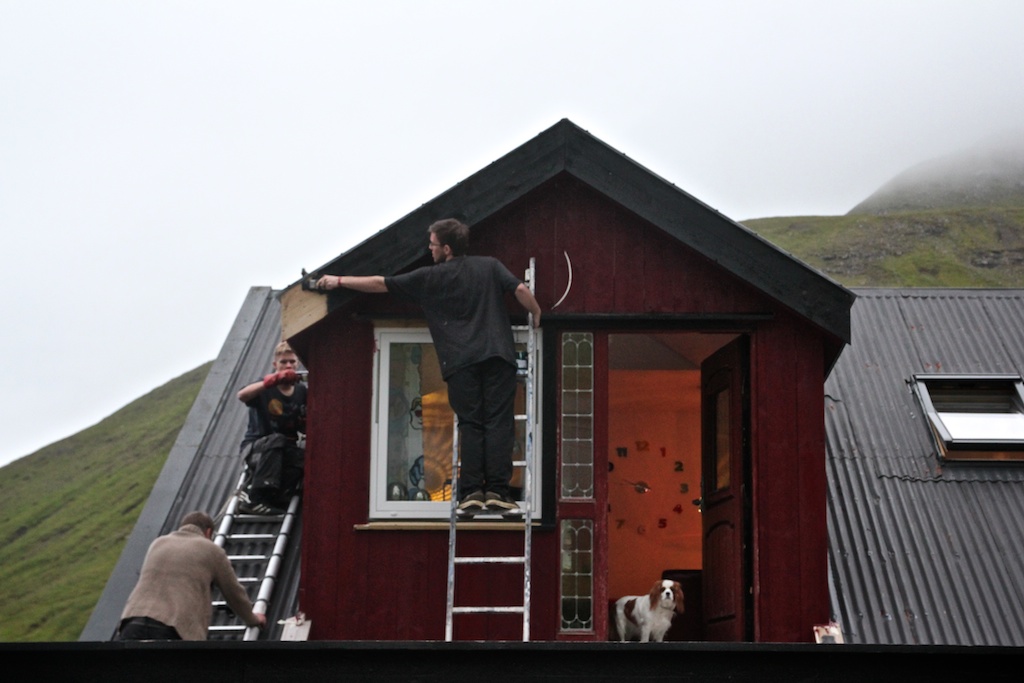
Painting houses in the summer weather.

As Jonhedin Herason Trondheim told me at a G! Festival planning meeting, “Yes, our summer is great. And it’s long. But it’s short and we have to fit in festivals, painting our houses, everything!”

Summer Fun at the G! Festival

Summer Fun at the G! Festival

Is it any wonder I’m struggling to find time to update my blog?

G! Comes to Gøta

The G! Festival, one of the biggest and most anticipated music festivals in the Faroese summer, takes place each summer in my own home village of Gøta! There’s camping in Norðragøta, a few events in Gøtugjógv, and the bulk of the action will happen on the stages of Syðrugøta, just a short walk away.

Preparations for G!

Preparations for G! in Syðrugøta

The main event begins today, but the festival spirit arrived yesterday afternoon with the most eager of the campers, who line up in anticipation of the opening of the camping area, sometimes 6-7 hours early (even though there is plenty of room for everyone!). Some of the groups have camp names, like “Flower Power” (who decorate their tents with flowers) and “The G! Spot” (what a pun). This year, like last year, the first campers on the scene were “Skopunhagen” who entertained other early arrivals with beer contests and quizzes before taking their rightful position at the very front of the line.

Herri from Skopunhagen is ready for the Tent Rush at G!

Herri from Skopunhagen is ready for the Tent Rush at G!

When the gates open, there is a mad rush to select the best spots and pitch your tent as quickly as possible. The frantic, confused efforts made it fairly clear that most of these people had not used their tents before and had also done a fair bit of pre-gaming. But that’s just part of the fun!

G! Tent Rush

G! Tent Rush

G! Tent Rush

G! Tent Rush

G! Tent Rush

G! Tent Rush

Residents of Gøta (except for yours truly, who was out in the field getting trampled to bring you these photographs) watched from windows and streets throughout the village, taking their own photos and videos of the “Tent Village” that springs up over the course of an afternoon to join Gøta every year for G!

G! Tent Village in Norðragøta

G! Tent Village in Norðragøta

The Halfway Point / By the Numbers

Time for just a quick update:

I’m about halfway through my Faroese summer, and nowhere near ready to leave. Right now, I’m wandering around in a bit of a midsummer haze. My days and nights are flipped almost completely upside down. I can’t remember the last time I went to bed before 4 am or got up before noon… I think it’s been a week. Mostly to break the cycle, I’ve planned a trip to Tórshavn and Nólsoy tomorrow, so I have to get up in time to take the 8 am bus.

I think it’s time to say I’ve learned what I’ve needed to learn and met the people I’ve needed to meet in order to really do the bulk of my work here. Of course I could still keep learning and practicing and preparing forever, but the halfway point is a good time to wake up and realize that I need to really get started on serious formal interviews, writing, and such.

In three weeks, things are going to start getting really crazy here. My last few weeks in the Faroe Islands are going to see the G! Festival in my home village, the Ólavsøka national day and festival in Tórshavn, and my best friend here taking off work for a few weeks so that we can travel around and see as much of the country as possible. So I’m going to try to get some of the work done now, before the summer really lights on fire…

Foggy Sunrise

Here’s what my halfway point looks like, by the numbers:

Days spent in the Faroes: 34
Days left in the Faroes: 39

Photos taken: 8,814

Faroese words I know: 2,000+ (ability to speak badly, unlocked!)
Manual gears acquainted with: 5 (ability to drive badly, unlocked!)

Faroe Islands Visited: 9
Vágar, Streymoy, Eysturoy, Borðoy, Viðoy, Kunoy, Kalsoy, Suðuroy, Koltur

Faroe Islands Unvisited: 9
Nólsoy, Hestur, Sandoy, Svínoy, Fugloy, Mykines (still plan to visit)
Skúvoy, Stóra og Lítla Dímun (maybe not this year)

Blog posts published: 12
Blog drafts sitting in the edit queue: 8 (!)

Formal interviews conducted and recorded: 4
Formal interviews planned for the coming week: 4

Cups of tea consumed: 69+
Containers of garlic cheese consumed: 7
Bags of “chokoflager” cookies consumed: 4

Potatoes peeled in the correct Faroese style: < 2
Potatoes peeled in Miranda’s crass, uncultured way:  > 15
Potatoes eaten unpeeled: > 15

Hours spent watching Dagur og Vika, reading Portal.fo and listening to Útvarp Føroya: 20+
Words in the “Comprehensive Faroese Vocabulary” Memrise course I’m helping create: 1,107

Faroese (and fellow Faroe-phile) Facebook friends: 58
Times mistaken for a Sea Shepherd Spy: 3+

New Definition of “Good Weather”: 10°C/50°F (and not rainy or foggy)
New Definition of “Hot Summer Weather”: 15.5°C/60°F (and maybe some sun)
New Definition of “Grass Green”: #00FF00
New Definition of “Large”: 500-inhabitant villages
New Definition of “Busy”: 8 cars in a parking lot

CJLCQ_7DTWV

Imagining the Faroes

Now that I have been in the Faroe Islands for a few weeks, I have gotten started with my research interviews. I plan to talk to several Faroe Islanders of varying ages, genders, and places of residence about how the Faroe Islands are represented to foreigners through various media channels, and how they feel about those representations.

So far, I have conducted three formal interviews and more than a dozen informal conversations on this topic. One trend that has started to suggest itself is that the older interviewees have been more positive about representations of the Faroe Islands than the younger interviewees, even suggesting that the tourism imagery shows the islands in an unrealistically good light, while the younger interviewees seemed more bitter about anti-whaling sentiment and outdated representations.

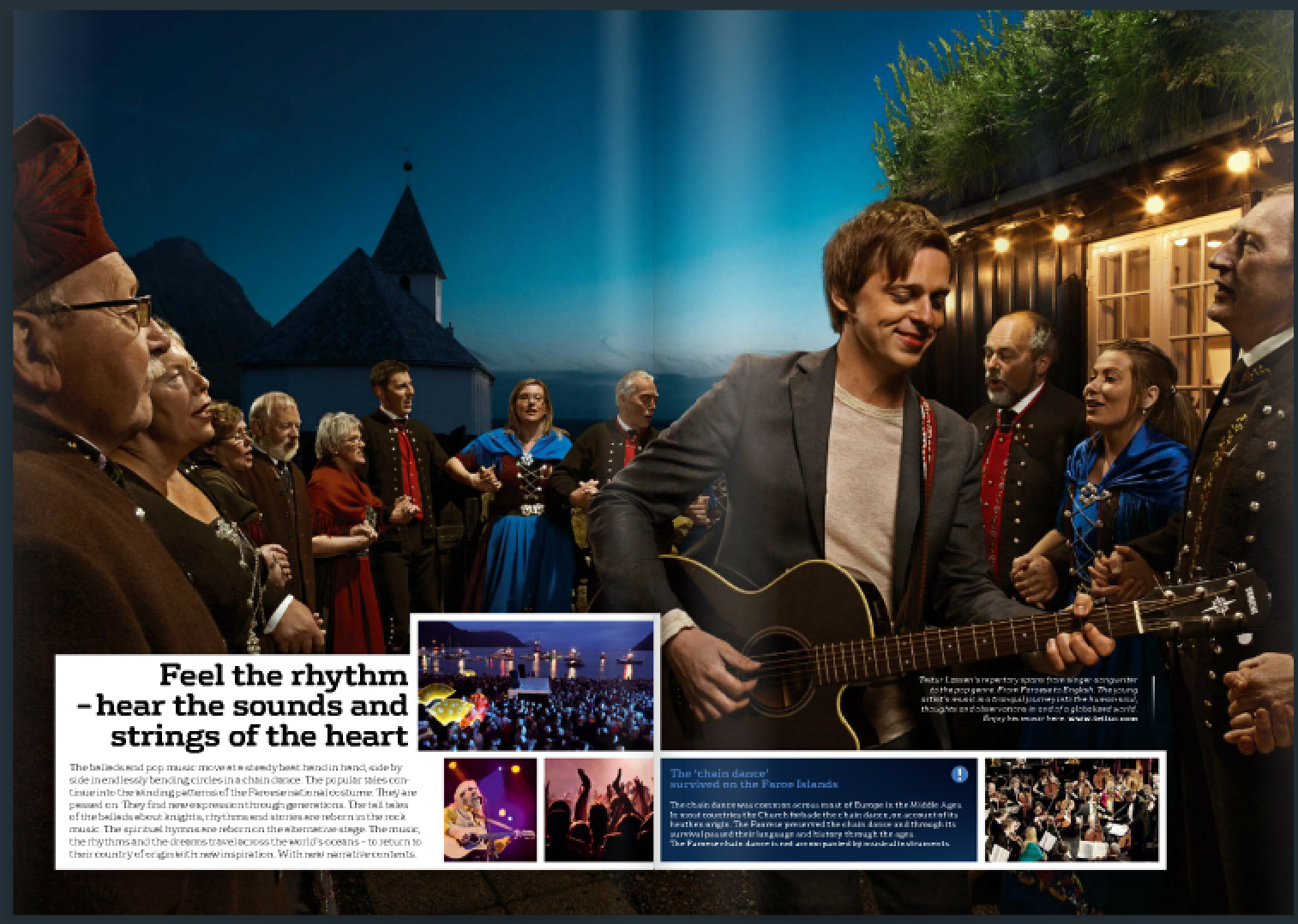
A two-page spread from Visit Faroe Islands' new tourism booklets. This is one of the images I ask respondents to consider during the last part of the interview.

A two-page spread from Visit Faroe Islands’ new tourism booklets. This is one of the images I ask respondents to consider in the final part of the interview.

One amusing wrinkle in the interviews has been that many respondents have recognized people they know in the example media I’m presenting to them. In my very first interview, I showed part of a video, and my interviewee asked me if I would like him to introduce me to the people speaking in the video. In another interview, when I showed the above photo of the Faroese ring dance, the interviewee told me that she recognized “almost everyone” in the photograph, as they were all from Klaksvík!

When I was planning the interviews, the possible frames I felt that I had seen in representations of the Faroe Islands were exotification (through emphasis on the traditional ways of life or the remote, wild natural conditions), trivialization (due to the nation’s small size), and conflict (presenting the Faroe Islands as backwards, especially in regards to the controversial grindadráp).

So far, no one has mentioned the trivialization frame, except to say that many people are not aware of the Faroe Islands at all. One man told me an anecdote in which he was travelling and tried to explain where he was from to some people who had never heard of the Faroes. He said that it was in between Scotland and Iceland, and they insisted that no such country existed. He looked around for a map of Europe, and when he found one, the map itself was missing the Faroe Islands! He had to find a second map to prove that he was, indeed, from a real place.

Here are the main points I’ve heard so far about depictions of the Faroe Islands:

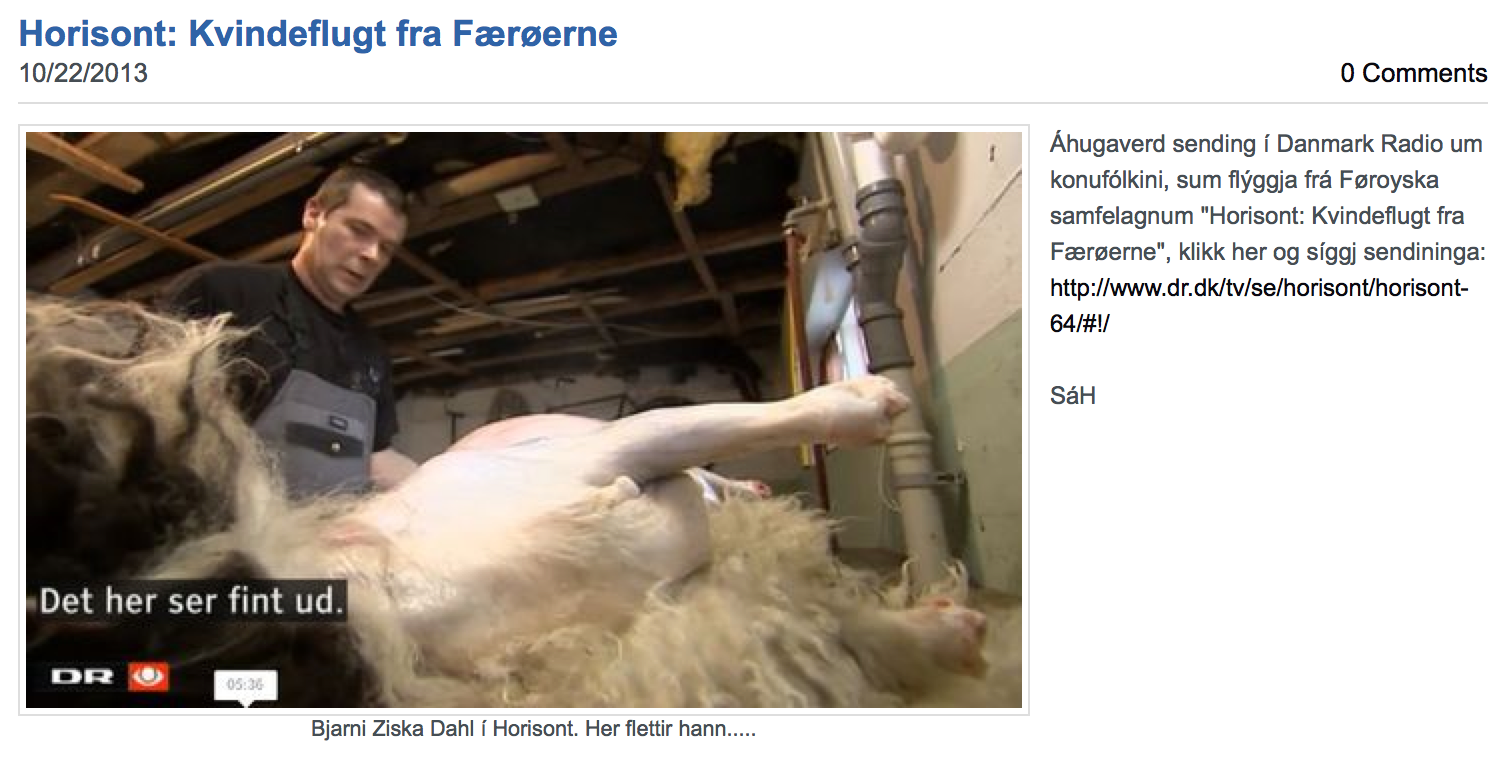
A screenshot and description of the Danish tv documentary, "Kvindeflugt fra Færoerne," which is about the gender disparity in the Faroe Islands.

A screenshot and description of the Danish tv documentary, “Kvindeflugt fra Færoerne,” which is about the gender disparity in the Faroe Islands. This is one of the images I ask respondents to consider in the final part of the interview.

– They focus more on old traditions, such as the ring dance, and less on growing, current trends like modern music and cuisine.
– They are antiquated, and haven’t caught up with the changes of the last 10-30 years.
– They imply that everyone in the Faroes is a sheep farmer or a fisherman.
– They play down or ignore the existence of modern institutions like hospitals, shops, and the University.

– Information about the Grindadráp is filled with inaccurate claims, such as that the pilot whales are endangered or killed for fun.

– They have beautiful photos and descriptions of the unique Faroese nature.
– However, they could be painting an unrealistic picture of good weather and endlessly clear skies, conditions which are rare in the Faroes though they do occur.
– They ignore the winter almost completely in favor of coverage of the brief tourism season (June-August).

– They are concerned that tourists might not understand that the Faroese weather is uncertain and changeable, and that everything in the Faroes is expensive.

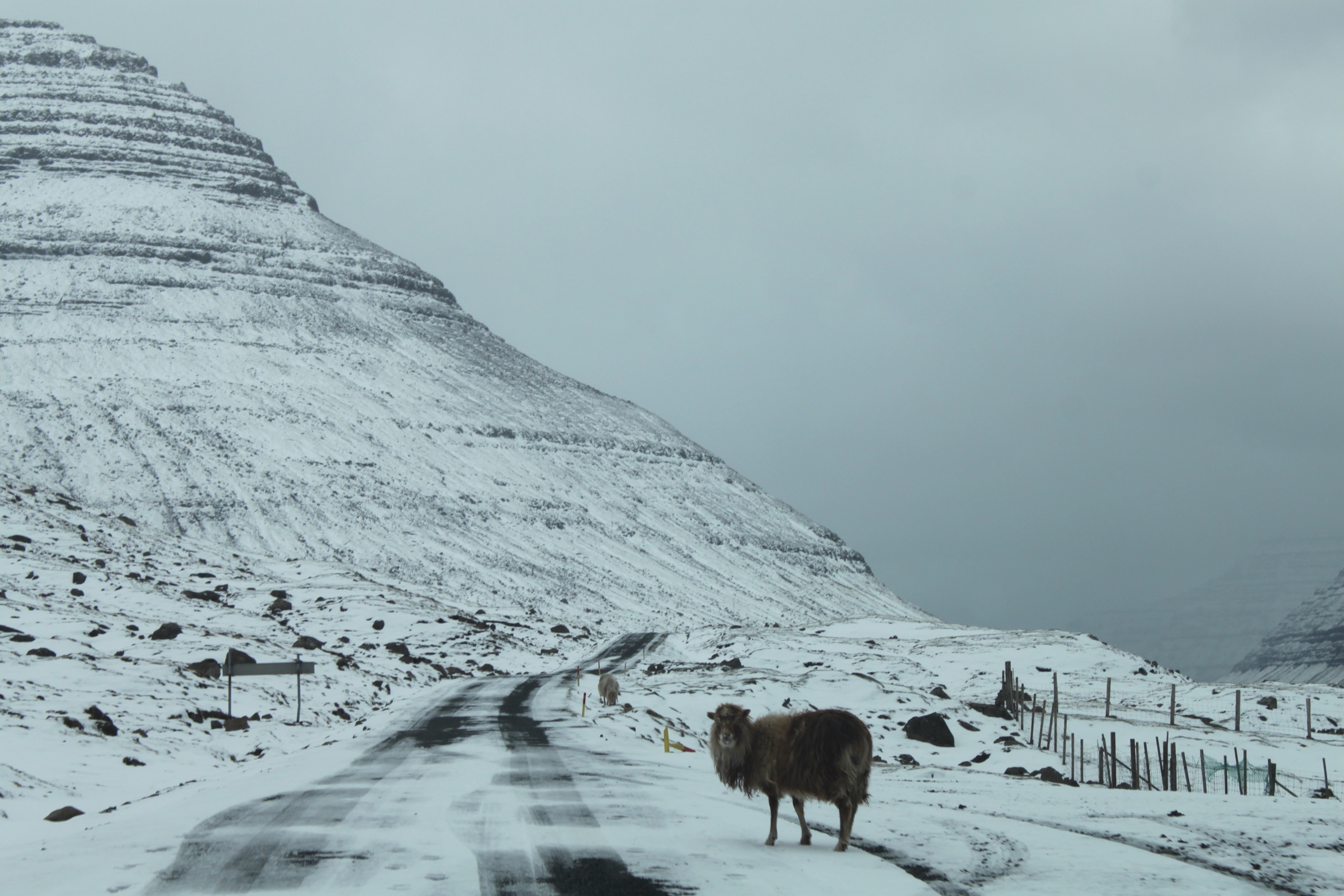
A sheep walking on the road leading to the village of Múli.

A sheep walking on the road leading to the village of Múli. This is one of the images I ask respondents to consider in the final part of the interview.

So far, one of the most intriguing things to come up in an interview was one woman’s suggestion that many of the problems she saw in representations of the Faroe Islands had the same problematic root — that foreigners almost never travel to the islands in the winter. Not only does that ignore more than half of the year in the Faroes, she thinks the long, dark, stormy winter has a huge effect on the Faroese culture, and that, without understanding that, it’s impossible to explain the Faroese mentality or perspective on a wide range of issues.

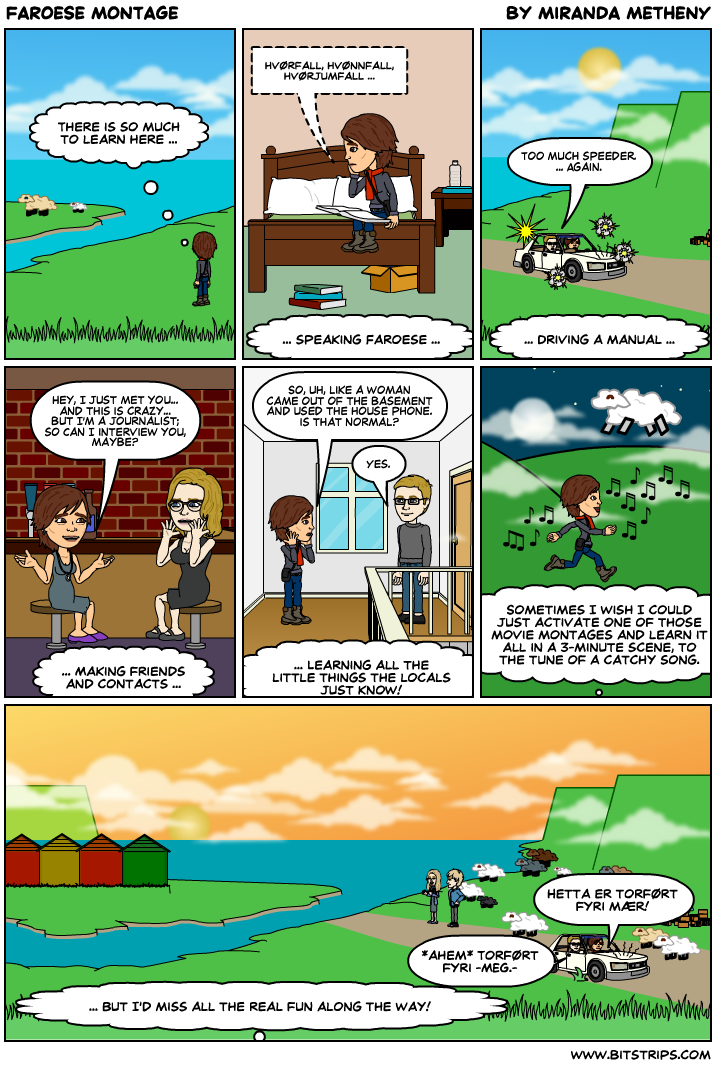
Faroese Montage

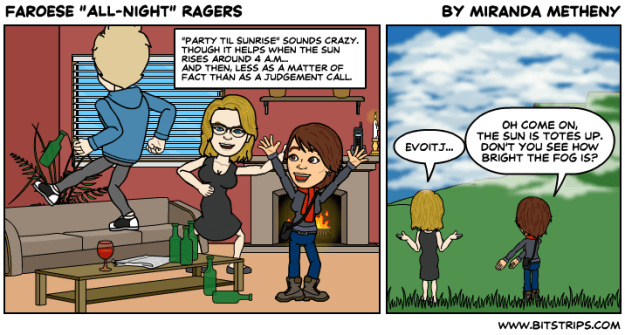
Montage Comic

Critical Skills Status Update:

My Faroese skills have improved to the point where I can explain my project, however badly and haltingly. This in and of itself feels like cause for celebration! I am also actually driving around, between villages, through tunnels, on mountain roads. Haven’t gone by myself yet, but I feel like I’m improving every time and no longer feel like I’m going to die — just potentially annoy every other driver on the road and maybe stall out the engine (sorry, little white car).

I’ve made a lot of contacts in the last week and feel much more prepared to get started with all the interviews and that sort of work now. Am I totally ready? Of course not. But I never will be. Still, I think things are going pretty well. And even if every day brings new challenges, that’s half the fun — so bring it on, Føroyar!