
Many ships have wrecked in the treacherous waters around the Faroe Islands. The stories — almost every village has at least one — are tragic and harrowing, though there are also wonderful accounts of Faroese bravery and hospitality. Remains of the ships, their cargo, and their crew, are scattered throughout the islands — in folk songs and church silver, in mass graves and monuments, and even in the ancestry of many Faroese people living today.
Update — in 2021, Bjørn Friður Mikladal created Skipsvrak.fo to catalogue all known shipwrecks in Faroese waters. It’s a very comprehensive page (in Faroese) that includes statistics, an interactive map, photos, and links to news sources for each shipwreck, including the ones I wrote about in this post and many others!
The following is a small sampling of notable foreign shipwrecks in the Faroe Islands:

Pirate Ships
Many of the earliest recorded foreign shipwrecks in Faroese waters took place near, or at least washed up on the shores of, the village of Hvalba in northern Suðuroy.
In 1615, the pirate ship Fortune had recently left Hvalba when it was wrecked in a storm. Apparently the captain, Thomas Tucker, had teamed up with another pirate named Jan Mendoses, and they were planning to plunder Northern Norway together. But when Fortune was wrecked, Mendoses robbed and abandoned Tucker.
In 1628, two large Turkish pirate ships attacked Hvalba. It’s a dramatic and tragic story that deserves its own post at some point, but suffice here to say that one of their ships sank, and you can still see the mass grave where the pirates were buried.
Skipsvrak.fo also lists a “Skip hjá John Fermus,” captained by the son of a Scottish smuggler, wrecking off Hvalba in 1640.
The Walrechen
In 1667, a convoy from the Dutch East India Company was coming from Java with a cargo of gems, silk, and spices when bad weather scattered the ships in the North Atlantic. One ship wrecked in South Iceland, and another, the Walcheren, wrecked on the Faroese coast between Kvívík and Leynar. Most of the Walcheren drifted west and sank off of Mykines, where its cannons have been found, though some pieces also washed ashore in Hvalba. The people of Mykines acquired some goods from the wreck.
The Norske Løve
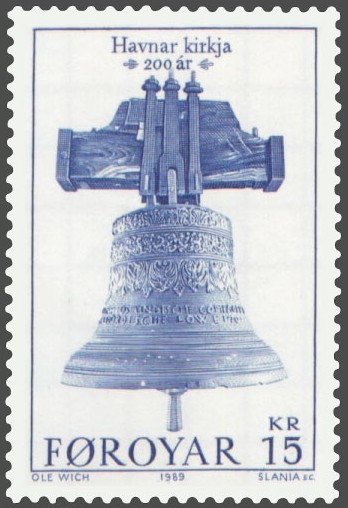
The bell in Tórshavn Cathedral, shown here on a Faroese stamp, was taken from the wreck of the Norske Løve.
In 1707, the Danish ship Norske Løve (Norwegian Lion) was traveling from Copenhagen to the West Indies when it ran into trouble. The big, 36-cannon ship was hit first by lightning, then by a breaker, and finally sank in Lambavík on New Year’s Eve. Approximately 100 men survived, but the ship was buried by a landslide in the night and lies now under both water and earth. The ship’s bell was recovered and is the main bell in Tórshavn Cathedral to this day, and a chair can be seen in the Blásastova museum in the village of Gøta. One of the votive ships in Tórshavn Cathedral is a model of the Norske Løve, said to have been made by one of the sailors rescued from the wreck. There is also a Faroese ring-dance song about the sinking of the Norske Løve.
The Westerbeek
In 1742, the Dutch ship Westerbeek shipwrecked on the west coast of Suðuroy, in a place called Lopranseiði. Travelling far off course in a dense fog on their way home with spices from Ceylon, the Westerbeek was caught and wrecked between a steep cliff and a line of skerries. Ten of the crew, who were sick and lying in bed at the time, went down with the ship, and another man died while trying to escape. But the other 80 men on board managed to reach safety by climbing the steep cliff and the broken mast of the ship. Faroese people from Vágur helped rescue them, and most of the men ended up spending the winter in the Faroe Islands.
The Westerbeek is one of the most famous shipwrecks to have happened in the Faroes. There is a Faroese book about the incident, and also a ring-dance song, Visen om Westerbeek. There are many stories about men from the ship who settled in the islands and left descendents. However, one of the only verified stories is that of Berent Schouten, the ship’s carpenter, who had a daughter with a girl from Vágar. Many Faroese people descend from Sunneva Barentsdatter.
Flotsam and Jetsam
In 1768, the brown rat is said to have come to Faroe Islands with the wreck of the Norwegian ship Kongen av Preussen (King of Prussia), which washed ashore in Hvalba — apparently where many Faroese tides lead!
The rats may not have been welcome, but abandoned foreign vessels have often proved beneficial for the Faroese people, as useful goods and building materials could wash ashore. When Primus, an abandoned Norwegian boat carrying a large quantity of timber, drifted to shore in Árnafjørður in 1875, the local cost of wood fell dramatically across the islands.
In 1828, the abandoned Scottish vessel Broom drifted ashore in Saksun, bearing large amounts of Canadian timber. Some 800 heavy wooden beams were salvaged, auctions, and used in various projects throghout the islands, including a major repair of the storm-damaged church in Hvalvík and the Brunn House in Nólsoy.
The Marwood
In 1847, the British ship Marwood was on its way from Africa to Liverpool when it lost its rudder in a winter storm. After drifting for three weeks, suffering from intense thirst, the ship was stranded near Viðareiði. The people of the village helped to rescue and care for the crew, and the British government later thanked them with a gift of fine silver, which can be found in the church of Viðareiði today.

The village of Viðareiði, where the surviving crew of the Marwood . © Miranda Metheny
Upon finally returning home, the 9 surviving crew members of the Marwood of Liverpool wrote the following statements:
“We were unable to land — sea running very high-strong current, and eddy winds — no food; some were eating palm oil, monkey skins, leather, horn buttons… we drank salt water, wine, liquid medicines…. On the 22nd John Lelland died, while sitting among the rest of the crew; and on the 23rd, horrid to relate, we opened the body, to endeavour to get a little blood, to quench our thirst. We would previous to that have buried the body, but were unable to do so by weakness; we made use of part of the body, and by so doing it gave us strength to save our lives; but our thirst was unabated; we licked the wood-works, when the dew had fallen, until the blood oozed from our lips and tongues.
Early on the morning of the 24th, finding ourselves much strengthened, by what we have before stated, we were determined to run all risk and abandon the ship, as we could no longer survive on board of her; the vessel was then nearly waterlogged. According to the above resolution, we, with great efforts, launched the boat, dropped her astern of the vessel, and one by one got into her, and left the ship. We made towards a bay, or what seemed to be so, but on nearing the land, we perceived the shore lined with cliffs of rocks, and appeared no place of landing. But the kind and merciful hand of God was out-stretched to help us; he had humbled us, and he was ready to save us.
We perceived a small inlet, where a stream of water ran from the hills; we made for that place and ran the boat in: it was the only place of landing, the boat went into the inlet as far as she could be got, but striking among the rocks, was dashed to pieces. Some of us reached the shore, others were unable to do so, until assisted by the strongest, and dragged from the receding surf. We discovered that we were landed where a small fishery was; one or two of the strongest of us went to discover inhabitants, they soon perceived a small village of three houses; the inhabitants were paying their devotions in a small church. On making known our circumstances by signs, as they could not speak English, they immediately ran to our assistance. We then discovered, for the first time, that we were on the island of Vederoe (Viðoy), Faroe Isles, —a Danish colony.
Words are too weak to express the kindness and humanity of these people; they received us as parents, they gave us cordials, they bathed us, they gave us warm drinks, warm clothes, and nourishing food; they placed us in warm beds, with stoves in the apartments; they attended us all night, with warm drinks; they shed tears at our sufferings; in fact they were all humanity and goodness.
We remained with these good people eight days, daily receiving further proofs of their kindness… We were divided, three in each cottage. On leaving these kind people, the Governor made them understand that we were willing to subscribe something handsome for their kindness; but they would not listen to such a proposal; they said they would have no reward from us, but trusted to strangers using their children in the same manner, should misfortune place them in similar circumstances. They parted from us with tears.”
The Principia
In 1895, the British ship Principia was traveling from Dundee to the United States when it caught fire in bad weather. The crew attempted to turn back towards Scotland, but the ship crashed in Søltuvík off the island of Sandoy. Only one man survived, lying on a wooden hatch for 14 hours until he was rescued in the village of Kirkjubøur. The hatch he clung to is now used as a table in Kirkjubøur’s Stokkastovan, the oldest house in the Faroe Islands.
The Casper
In 1918, the Danish ship Casper was bringing a cargo of salt from Ibiza to the Faroes when it was driven onto the cliffs of Lítla Dímun, the only uninhabited island in the archipelago. The six members of the crew, including the badly injured captain, managed to reach first a narrow ledge just above the surf, and then a cabin partway up the island. They found matches, fuel, and a lamp, caught two sheep and a sick bird, and survived there for 17 days before they were discovered and rescued. One of the sailors settled in the Faroe Islands permanently.
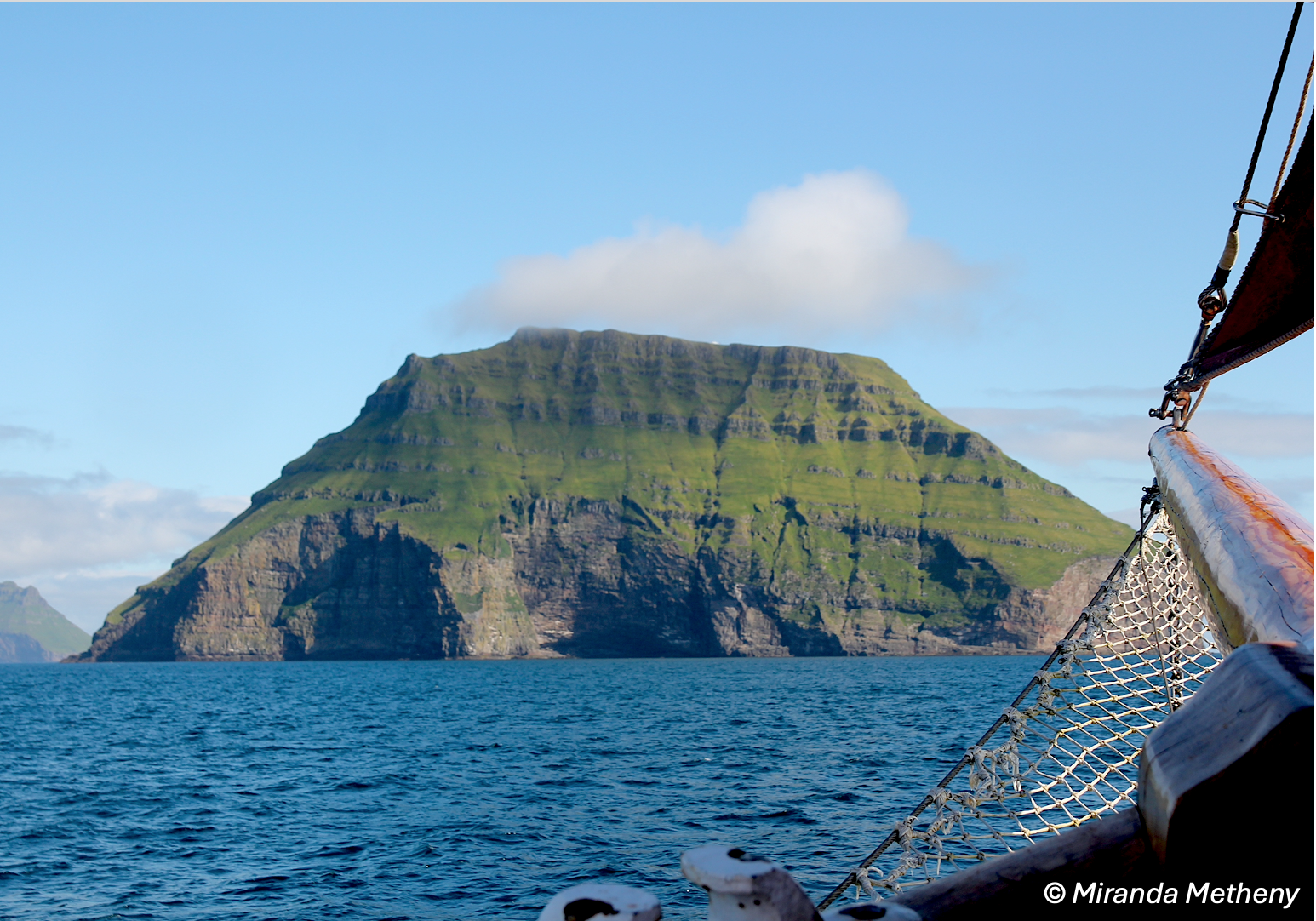
The tiny, nearly inaccessible island of Lítla Dímun, where the crew of the Casper survived for 17 days before they were discovered and rescued. © Miranda Metheny
The Girdlesness
The Girdlesness sank off the coast of Suðuroy in 1931. All eleven men on board perished.
The Faroese newspaper Dimmalætting wrote at the time:
“Trawleren 782 Girdleness er natten til fredag strandet ved den stejle og utilgængelige kyst sydfor Famien (Skortabarm) og adskilt i to dele. Hele besætningen er omkommet. Mænd fra Famien blev i gaar nedhejst i line og der er paa strandingstedet fundet løsrevne arme og ben samt forskellige menneskerester. Forsøg paa at komme til vraget vil blive gjort i morgen.”
“The trawler Girdleness was stranded on the steep and inaccessible coast south of Fámjin on Friday night and seperated into two parts. The entire crew has perished. Men from Fámjin were hoisted down on lines yesterday and found severed arms and legs along with various other human remains. Attempts to reach the wreck will be made tomorrow.”
A silver chalice with a plate and a golden cross were gifts to the church of Fámjin from the British government as thanks to the village for giving the crew a respectful funeral.
WWII and the Christmas Ship
During WWII, several foreign ships and planes crashed in the Faroe Islands. One was the Lincoln City, an anti-submarine warfare trawler in the British Royal Navy. In 1941, it was bombed in an air raid and sank outside of Tórshavn, killing all eight men on board.
The story of the SS Sauternes is one of the saddest in this list. The steamship was coming into the Faroe Islands laden with supplies including fuel, Danish currency minted in the UK for use on the islands, and Christmas presents. The locals called it Jólaskipið, the Christmas Ship, and were eagerly awaiting its coming.
The Sauternes was not made for the conditions of the North Atlantic, but in wartime, compromises must sometimes be made. A storm was rising as the boat reached the Faroe Islands, and the ship could not reach Tórshavn. The crew telegraphed their position to the Naval Headquarters in the capital. At that time, they were in Fugloyarfjørður, the narrow stretch of water separating the small islands of Fugloy and Svínoy in the northeast. However, the Naval Headquarters believed that the ship was in the similarly named Fuglafjørður, which is a safe haven protected from the open sea, so they ordered the Sauternes to drop anchor.
The storm intensified, and the Sauternes sank as locals looked on helplessly from shore. All 25 passengers and crew were lost, and only 6 bodies were ever recovered; these were buried in Klaksvík. The Faroese have never forgotten the Jólaskipið, and there is a book about the tragic event. The wreck occurred the same day as Pearl Harbor, another tragedy on another archipelago on the other side of the world.

The cliffs of Svínoy in Fugloyarfjørður, where Jólaskipið met its end. © Miranda Metheny
More Recent Crashes
Treacherous reefs and weather conditions continue to wreck ships around the Faroe Islands in recent times.
In 1957, the Icelandic trawler Goðanes crashed into a reef as it entered Skálafjørð on Eysturoy. The Faroe Islanders wanted to rescue the crew, but they didn’t have the necessary equipment, and the captain died in the accident. Afterwards, Slýsavarnafelag Íslands, the rescue association of Iceland, donated rescue equipment to the Faroe Islands, inspiring the establishment of rescue organizations around the islands. A formal rescue service was established in 1976.
In 2007, the Russian trawler Olshana ran aground at a reef called Flesjarnar on its way out from Kollafjørður. “Flesjarnar” is a dangerous reef lying in the waters between Streymoy and Eysturoy, and it has sunk many boats throughout history. Olshana’s entire crew was rescued, but the trawler sank immediately when it was pulled off the reef the next day. Several ships now rest at the bottom of the sea in that area, many carrying significant amounts of oil.
 Adventures in the Land of Maybe
tank you i love to read youer storys you now a loth abouth føroyar heilsan ein havnarmaður
Hey! Takk fyri vitjan. 🙂
Can anyone help me with the name of the Ship that was crushed on the rocks at Suduroy in the 1930s – although the local people tried to help the sailors all perished and their remains are in the churchyard with a simple stone now illegible. I believe the ship came from the UK. I would be grateful for any help
Your comment is very interesting. Do you remember what village/churchyard the stone was in? I have heard a few things about a similar shipwreck, but am still trying to find more information. We might be looking for the same one.
Thank you for your reply. I have now discovered that the ship was a trawler and named The Girdleness after a headland, near Aberdeen where it was based. There is still the Girdleness lighthouse on this headland. I contacted a friend from Aberdeen, who sent me on the correct trail.
The village where the stone is placed is Famjin. The shipwreck occurred in 1931.
I do hope this helps you.
This blog may be old, but I’ll post a comment all the same. With regards to the wreck of the Norwegian Lion or rather the salvage that they managed to get a hold of before it was covered and most likely sunk by a landslide (if memory serves…). I own a rather large desk that has been passed on to me. It ended up in my family as a wedding gift to my either my great-great or great-great-great grandmother from her employer the Amtmaður (Governor), she had been a domestic servant prior to marriage. The family legend states that the desk was salvaged from off Norsku Løvu, ended up at the Amtmansborg and was then gifted to this foremother of mine. I know of two sources (an article in a booklet by Eysturoya Fornminnisfelag, I think) and a book about Norske Løve, where the desk is mentioned and my father is named as the owner of the desk… the thing is… when the booklet was published it was actually owned by my father’s grandmother and when the book was published it had been mine for a year (hadn’t taken possession of it though, but my grandmother had said that I could have it).
That’s a very cool story. Thank you for sharing!
I too was interested in that story and took a picture of the headstone but when I was in Famjin a few years ago. As you say, it is not easy to read but I researched the story at the time but can no longer find where I read the owners were so grateful to the people of Famjin for their attempts to save the crew that they gave some silverware to the local church where I am told it is to this day.
There are details of the loss on this site.
Old story and, as said, the gravestone is now illegible but I took a photograph some years ago and also read the story that the owners of the Girdlestone presented the village with some items of silver to commemorate the loss and to give thanks to the villagers,. The items were at one time on display in the church, the same church where the Faroes Flag first saw the light of day. There is more on the loss on https://www.wrecksite.eu/wreck.aspx?256661
Thank you for sharing! I’ll update the post.
Girdleness of course! There is also a mention of the casualties on
https://www.wrecksite.eu/peopleView.aspx?y27xCtNqeXijStUhqA7psA==